Monday, January 17, 2022

Do Needlepoint Bipolar Ionizers Kill COVID-19? According to Experts, No

Camfil Experts Say Needlepoint Bipolar Ionizers Don’t Kill COVID-19. Learn more here.

In 2021, an expensive trend took hold as school districts searched for a way to make in-person instruction safe for students. School districts across the United States have spent tens of millions of dollars in federal government relief funds installing expensive needlepoint bipolar ionizers under the belief  that they would protect students against COVID-19 infection by killing viruses in the air. 

The problem: they may not actually work and in fact make an appearance in RealClearScience biggest junk science of 2021 article. 

What Do Ionizers Do?

Ionizers release charged molecules (ions) into the air. Manufacturers of ionizers claim that these negatively or positively charged ions have a range of seemingly miraculous effects, including trapping allergens, reducing stress and anxiety, improving sleep, and even killing the virus that causes COVID-19.

However, there is little evidence to back up these claims.

Do Ionizers Actually Work Against Viruses?

ASHRAE, the American Society of Heating, Refrigeration and Airconditioning Engineers, which is the professional organization that makes recommendations to governments and institutions in regards to appropriate air filtration and ventilation systems, has commented the following on the use of ionizers as protection against COVID-19 (1):

“Relative to many other air cleaning or disinfection technologies, needlepoint bi-polar ionization has a less-documented track record in regards to cleaning/disinfecting large and fast volumes of moving air within heating, ventilation, and air conditioning (HVAC) systems. This is not to imply that the technology doesn’t work as advertised, only that in the absence of an established body of evidence reflecting proven efficacy under as-used conditions, the technology is still considered by many to be an ‘emerging technology.’ Convincing scientifically-rigorous, peer-reviewed studies do not currently exist . . . Systems may emit ozone, some at high levels.”

In other words, though ASHRAE has yet to take a firm stance on the effectiveness of bipolar ionizers as a means of protecting people in public spaces against COVID-19, they do assert that there simply isn’t enough evidence to rely on ionization technology. 

The CDC has made a similar statement (2), additionally noting that some variation of these technologies has been around for decades, and evidence in their favor has yet to be established. 

As other air filtration experts and engineers have previously pointed out, the research that points to the supposed effectiveness of these devices is severely lacking in several domains:

  1. None of the research is peer-reviewed, meaning that the findings of the studies haven’t been replicated, and their methodologies haven’t been found to be sound enough for publication in any reputable scientific journals. 
  2. Much of the research is funded and organized by the manufacturers of the ionizers themselves, so there is a definite bias in the conditions and methods chosen, and therefore in the results themselves.
  3. The conditions under which ionizers have been tested do not translate to real-life situations. For example, some studies test the devices in tiny rooms that don’t represent any real-life situation, while others fail to account for close, unmasked contact between people, which is responsible for much of the spread of the virus.
  4. The studies lack an experimental control condition to establish any actual causal link. 

Related: Air Filtration Expert Explains ASHRAE Standard-170-2017 Addendum-A 

Are Ionizers Safe?

Not only is it unlikely that ionizers are providing the protection that manufacturers claim they are, but some ionizers also emit ozone, and potentially at high levels. Ozone is a pollutant that can cause respiratory irritation, migraines, and dizziness, as well as decreased productivity and cognitive function. 

There are two primary goals when it comes to returning students to in-person instruction. First, social interaction with peers is essential for meeting social and developmental milestones. Second, in-person instruction increases the effectiveness of retention and learning for many students by providing motivation and the opportunity for a range of learning activities. 

If students are getting sick in school because of ozone buildup in their classrooms and their learning is being inhibited, the goal of improved learning over online instruction is undermined. 

Related: How Does Air Quality Impact Learning And Productivity In Schools? Air Pollution And Productivity Explained 

Air Filtration and Ventilation Protects Against COVID-19

A solution that is endorsed by ASHRAE and the CDC for protection against the spread of COVID-19 is the use of effective air filtration and adequate ventilation.

By using the appropriate MERV-A-rated filters in your building’s HVAC system, or choosing an in-room air purifying unit that uses HEPA filtration, you can actually trap virtually all  of the infected virus particles that cause the spread of COVID-19. 

Air purifiers with HEPA filters that have been scan tested and certified as H14 are 99.995% efficient on MPPS which stands for the “Most Penetrating Particle Size.” MPPS is  the particle size that is most difficult for the filter to capture. In most cases, MPPS is between 0.1 and 0.2 micron. The SARS-CoV-2 virus is generally sized at 0.125 micron but is usually encapsulated within a respiratory aerosol which makes the overall particle even larger and captured at a rate higher than 99.995%.  Once trapped in the dense media of a HEPA filter , virus particles cannot escape. 

When combined with adequate ventilation, which prevents the buildup of infected particles and reduces the chances of infection, public building occupants can be protected against COVID-19.

Read more about air filtration and COVID-19 here. 

About Camfil Clean Air Solutions

For more than half a century, Camfil has been helping people breathe cleaner air. As a leading manufacturer of premium clean air solutions, we provide commercial and industrial systems for air filtration and air pollution control that improve worker and equipment productivity, minimize energy use, and benefit human health and the environment. We firmly believe that the best solutions for our customers are the best solutions for our planet, too. That’s why every step of the way – from design to delivery and across the product life cycle – we consider the impact of what we do on people and on the world around us. Through a fresh approach to problem-solving, innovative design, precise process control, and a strong customer focus we aim to conserve more, use less and find better ways – so we can all breathe easier.

The Camfil Group is headquartered in Stockholm, Sweden, and has 33​ manufacturing sites, six R&D centers, local sales offices in 30 countries, and about 4,80​0 employees and growing. We proudly serve and support customers in a wide variety of industries and in communities across the world. To discover how Camfil USA can help you to protect people, processes and the environment, visit us at www.camfil.us/ 


##


Media Contact: 

Lynne Laake 

Camfil USA Air Filters 

T: 888.599.6620 

E: Lynne.Laake@camfil.com

F: Friend Camfil USA on Facebook

T: Follow Camfil USA on Twitter 

Y: Watch Camfil Videos on YouTube

L: Follow our LinkedIn Page


Sources:

  1. https://bit.ly/33DOR2p
  2. https://bit.ly/3fAyyWM

The post Do Needlepoint Bipolar Ionizers Kill COVID-19? According to Experts, No appeared first on Air Filters for Clean Air.


from Air Filters for Clean Air

Friday, January 7, 2022

Air Pollution and COVID-19 — Study Shows Exposure to Air Pollution Increases Risk of Getting Sick with  COVID-19 

Air Pollution and COVID-19 — Study Shows Exposure to Air Pollution Increases Risk of Getting Sick with  COVID-19 

A recent study led by the Barcelona Institutes of Health has provided the strongest evidence of a link between ambient air pollution and COVID-19. Specifically, the study was the first to show that chronic exposure to ambient air pollution increases the risk of developing the COVID-19 disease when exposed to the SARS-CoV-2 virus. This association was most pronounced in severe cases of COVID-19. 

The study was published in Environmental Health Perspectives, an open access peer-reviewed journal supported by the United States National Institute of Environmental Health Sciences. The study relied on data from 9605 participants based in Catalonia, an area of northeastern Spain that encompasses the provinces of Barcelona, Girona, Lleida, and Tarragon. 

SARS-CoV-2 Infection vs COVID-19 Disease

To understand the impact of the study’s results, it’s important to understand the distinction between SARS-CoV-2 infection and COVID-19 disease. COVID-19 disease occurs when an infection with the SARS-CoV-2 virus causes the symptoms we’re familiar with; shortness of breath, body aches, fever, respiratory irritation, and loss of taste or smell. However, SARS-CoV-2 infection can occur without causing any symptoms of COVID-19. These cases are referred as asymptomatic cases. 

Some of the symptoms of COVID-19, such as fever and coughing, are the body’s attempts to kill or expel the virus from the body. In asymptomatic cases, the immune system is able to fight and eliminate the virus without producing any of these responses. 

Because many people don’t get tested unless they are already showing COVID-like symptoms or have recently been exposed to a known COVID-19 case, and therefore may have carried the infection without knowing it, it is difficult to estimate how many SARS-CoV-2 infections have been asymptomatic. 

The Link Between Air Pollution and COVID-19 Disease

Between June and November of 2020, participants, most of whom ranged from 40 to 65 in age, were tested for antibodies indicative of having been previously exposed to the SARS-CoV-2 virus. Approximately 20% of the participants who were tested for antibodies showed evidence of having previously had SARS-CoV-2 infection.

Participants in the study were classified as having had COVID-19 disease if they had previously been admitted to the hospital for symptoms, had received a positive result on a diagnostic test, or had experienced three or more COVID-19 symptoms after known contact with a COVID-19 case. 481 participants (5% of the sample) were classified as having had COVID-19.

To determine participants’ exposure to air pollution prior to the pandemic, researchers used a model developed by the Effects of Low-Level Air Pollution: A Study in Europe (ELAPSE) project to estimate the levels of various pollutants at their residential addresses during the 2018-2019 period. The ELAPSE model uses air pollution monitoring data, satellite observations, dispersion model estimates, land use, and traffic variables as predictors to estimate pollution levels in a given area. 

The following pollutants were measured in the study: 

  • PM2.5 (fine particulate matter)
  • Black carbon
  • Nitrogen dioxide (NO2)
  • Ozone (O3)

Researchers were able to draw two important conclusions from the results of the study:

  1. Air pollution exposure was NOT significantly correlated to an increased likelihood of SARS-CoV-2 infection. However, in asymptomatic patients, higher levels of air pollution were correlated with a greater magnitude of antibody response. In other words, the more a person was exposed to air pollution before the pandemic, the harder their body had to work to eradicate the virus. 
  2. Air pollution exposure WAS correlated to the onset of COVID-19 disease, i.e. symptomatic COVID cases. In particular, NO2 and PM2.5 were most strongly correlated with the severity of the disease. Higher exposure to NO2 and PM2.5 meant more severe symptoms.

Though previous studies have indicated that SARS-CoV-2 may be able to survive on particulate matter pollution in outdoor air, thus increasing the distance it can travel, the results of this study did not support the hypothesis that air pollution aids the spread of COVID-19. 

Instead, the study shows that air pollution exposure (particularly NO2 and particulate matter exposure) increases host susceptibility to the disease and decreases immune system capabilities required to fight it.  

Why Do Polluted Areas Have More COVID-19 Cases?

Previous studies mostly examined symptomatic cases of COVID-19, but did not account for people infected with the SARS-CoV-2 virus who were asymptomatic. The problem with using samples that only contain infected individuals with symptoms is that it is impossible to distinguish whether long-term exposure to air pollution aided the spread of the virus, or long-term exposure to air pollution increased the likelihood of developing symptoms and serious complications when infected with the virus. 

If the former were true, higher instances of COVID-19 disease in more polluted areas could be attributed to other factors characteristic of those areas such as higher population density.  

By including more than just hospital patients to account for asymptomatic cases, this study has been able to isolate the presence of the virus from the onset of symptoms and examine their relationships to air pollution exposure. As a result of discovering this distinction, we have further evidence that adequate air filtration and ventilation in public and residential buildings will reduce the risk of developing COVID-19. 

Air Filtration to Lower the Risk of COVID-19

The findings of this study have useful applications in schools, offices, hospitals, public buildings, and even at home. 

In the United States, indoor air can be fifty times more polluted than outdoor air. This is because indoor sources of air pollutants, such as VOCs (volatile organic compound) off-gassing from furniture, cleaning fluids, air fresheners, and other sources are often overlooked. Additionally, pollutants that enter from outdoor sources become trapped in buildings with poor ventilation, leading to a buildup of these pollutants over time. 

While the study looked at air pollution exposure prior to the pandemic, the two year period measured ended approximately six months prior to antibody testing, meaning that improving the quality of air we breathe now will improve our immune system responses to the virus in the near future. 

Furthermore, the SARS-CoV-2 virus is spread via respiratory droplets and aerosols from infected individuals. These droplets and aerosols can be similar in size to particulate matter, and can be removed from the air by the same technology.  

One solution recommended by our team of air filtration experts here at Camfil is the City M air purifier. The City M is a standalone in-room unit (meaning that it works independently of your building’s HVAC system and does not require any special equipment or installation) that uses both HEPA filters and activated carbon filters to target particulate matter and gaseous pollutants such as NO2.

Read more about the City M here. 

About Camfil Clean Air Solutions

For more than half a century, Camfil has been helping people breathe cleaner air. As a leading manufacturer of premium clean air solutions, we provide commercial and industrial systems for air filtration and air pollution control that improve worker and equipment productivity, minimize energy use, and benefit human health and the environment. We firmly believe that the best solutions for our customers are the best solutions for our planet, too. That’s why every step of the way – from design to delivery and across the product life cycle – we consider the impact of what we do on people and on the world around us. Through a fresh approach to problem-solving, innovative design, precise process control, and a strong customer focus we aim to conserve more, use less and find better ways – so we can all breathe easier.

The Camfil Group is headquartered in Stockholm, Sweden, and has 33​ manufacturing sites, six R&D centers, local sales offices in 30 countries, and about 4,80​0 employees and growing. We proudly serve and support customers in a wide variety of industries and in communities across the world. To discover how Camfil USA can help you to protect people, processes and the environment, visit us at www.camfil.us/ 

##

Media Contact: 

Lynne Laake 

Camfil USA Air Filters 

T: 888.599.6620 

E: Lynne.Laake@camfil.com

F: Friend Camfil USA on Facebook

T: Follow Camfil USA on Twitter 

Y: Watch Camfil Videos on YouTube

L: Follow our LinkedIn Page

 https://www.sciencedaily.com/releases/2021/11/211117103904.htm

https://ehp.niehs.nih.gov/doi/10.1289/EHP9726

http://www.elapseproject.eu/


The post Air Pollution and COVID-19 — Study Shows Exposure to Air Pollution Increases Risk of Getting Sick with  COVID-19  appeared first on Air Filters for Clean Air.


from Air Filters for Clean Air

Saturday, January 1, 2022

COP26 Highlights Air Pollution-Related Deaths and the Global Need for Air Filtration 

COP26 Highlights Air Pollution-Related Deaths and the Global Need for Air Filtration 

The devastating impact of air pollution on human health was a central issue at the United Nations Climate Change Conference (COP26). 

A delegation of mothers from around the world — Brazil, India, Nigeria, Poland, South Africa, and the UK, specifically — presented a letter to the president of the conference calling on world leaders to limit air pollution and protect children who are being harmed by its effects. One of the women’s daughters, who passed away last year, was the first person in the UK to have air pollution listed as her official cause of death. 

The letter was signed by 500 parent groups from 44 countries, showing a global need to protect children from the effects of air pollution.

The World Health Organization names air pollution as one of the biggest threats to human health globally. In 2019 in Delhi, which is one of the world’s most polluted cities, air pollution contributed to the deaths of  more people than any other risk factor. The risk of fatal air pollution-related health complications is greater for children from poor families, a New York Times investigation found, because they spend more time outdoors and are more likely to use wood-burning stoves for cooking and as a source of heat. 

Global Health Risks Associated with Air Pollution — What Are the Health Effects of Air Pollution?

In September of this year, the World Health Organization (W.H.O.) published a report detailing the effects of air pollution on human health. Exposure to polluted air is known to cause seven million premature deaths yearly and can aggravate asthma, cause lung infections, and reduce lung growth and function. In 2019, at least 90% of people across the world lived in areas where pollution levels exceeded W.H.O. guidelines.

The effects of air pollution on health are seen close to home, too. In the United States, at least 40% of people live in areas with dangerous levels of pollution  per the same W.H.O. guidelines.  According to the Environmental Defense Fund, “children, the elderly, people with existing diseases,  minority and low-income communities are particularly vulnerable to adverse health outcomes and economic impacts, such as missed work days, from exposure to air pollution.” 

The exact effects of exposure to air pollution depend on the composition of the pollution itself, as well as the duration and intensity of the exposure. For example, long-term exposure to polluted air from living in a city will have different effects on different parts of the human body than short-term exposure to intense smog, wildfire smoke, or other abnormally high concentrations of pollution in one area. 

Air Pollution and the Respiratory System

A long history of research indicates that short-term exposure events involving high concentrations of air pollutants cause adverse effects on the lungs and other parts of the respiratory system. But long-term exposure to lower concentrations of pollution can have similar effects, including: 

  • Nose and throat irritation.
  • Bronchoconstriction (narrowing of the airways) and dyspnoea (difficulty breathing), particularly in asthmatic individuals, following exposure to sulfur dioxide, nitrogen oxides, and some heavy metals. 
  • Worsened symptoms in individuals with lung disease, lung lesions, and other respiratory conditions. 
  • Increased susceptibility to respiratory infections, especially following exposure to nitrogen oxides. 
  • Lung cancer, asthma, and emphysema caused by exposure to heavy metals. 


Air Pollution and the Cardiovascular System

The cardiovascular system is closely connected to the respiratory system and is responsible for circulating oxygen around the body. Effects of air pollution on the heart, blood vessels, and other parts of the cardiovascular system include: 

  • Reduced organ function, including brain function after carbon monoxide exposure, because carbon monoxide bonds to hemoglobin in the blood and reduces the capacity to deliver oxygen to vital organs and other parts of the body. This can lead to impaired concentration, slow reflexes, and confusion.
  • Ischemic heart disease can be caused by exposure to dioxins, which are formed when chlorine containing compounds and hydrocarbons are burned together. 
  • Tachycardia (a heartbeat exceeding 100 beats per minute), increased blood pressure, and anemia following exposure to heavy metal air pollution. 

Air Pollution and the Nervous System 

The nervous system is mainly affected by exposure to dioxins and heavy metal air pollution. Health effects of air pollution on the nervous system can include: 

  • Neurotoxicity leads to neuropathies (nerve damage) in the brain, which can lead to symptoms including memory disturbances, sleep disorders, anger, fatigue, hand tremors, blurred vision, and slurred speech. These effects have been observed in patients exposed to arsenic, lead, and mercury in air pollution. 
  • Lead exposure from air pollution is known to injure neurotransmitter circuitry; in particular, the dopamine system, the glutamate system, and the NMDA receptor complex, which are all important for memory function, are most affected by lead exposure. 
  • In children, dioxin exposure decreases the speed of nerve conduction and impairs mental development. 

Air Pollution and the Urinary System 

Exposure to heavy metals can cause kidney damage, as well as increase the likelihood of developing kidney stones and nephrocalcinosis (excessive calcium deposits within kidney tissue). 

Air Pollution and the Digestive System

Dioxin exposure causes an increase of certain liver enzymes in the blood, which indicates liver cell damage. Dioxin exposure is also linked to gastrointestinal and liver cancers. 

Air Filtration to Protect Human Health 

Efforts to reduce the source of air pollution globally to prevent premature deaths and harmed health will require long-term commitments from governments and industries across the world. But that doesn’t mean that the devastating effects of air pollution on our lungs can’t be alleviated locally.

Pollutants can be filtered out of the air before they enter public buildings (including offices, schools, grocery stores, hospitals and healthcare centers) and residential buildings with high efficiency air filters engineered to capture the particles and gases that create  indoor air pollution. The result is cleaner  air with every breath..  Read more about commercial and residential air filtration solutions here. 

About Camfil Clean Air Solutions

For more than half a century, Camfil has been helping people breathe cleaner air. As a leading manufacturer of premium clean air solutions, we provide commercial and industrial systems for air filtration and air pollution control that improve worker and equipment productivity, minimize energy use, and benefit human health and the environment. We firmly believe that the best solutions for our customers are the best solutions for our planet, too. That’s why every step of the way – from design to delivery and across the product life cycle – we consider the impact of what we do on people and on the world around us. Through a fresh approach to problem-solving, innovative design, precise process control, and a strong customer focus we aim to conserve more, use less and find better ways – so we can all breathe easier.


The Camfil Group is headquartered in Stockholm, Sweden, and has 33​ manufacturing sites, six R&D centers, local sales offices in 30 countries, and about 4,80​0 employees and growing. We proudly serve and support customers in a wide variety of industries and in communities across the world. To discover how Camfil USA can help you to protect people, processes and the environment, visit us at www.camfil.us/ 


##


Media Contact: 

Lynne Laake 

Camfil USA Air Filters 

T: 888.599.6620 

E: Lynne.Laake@camfil.com

F: Friend Camfil USA on Facebook

T: Follow Camfil USA on Twitter 

Y: Watch Camfil Videos on YouTube

L: Follow our LinkedIn Page


Sources:

  1. https://www.edf.org/health/health-impacts-air-pollution
  2. https://www.nytimes.com/2021/11/05/world/europe/cop26-mothers-pollution.html
  3. https://climatenexus.org/wp-content/uploads/2015/09/HumanHealthEffectsofAirPollutionKampaandCastanas.pdf

The post COP26 Highlights Air Pollution-Related Deaths and the Global Need for Air Filtration  appeared first on Air Filters for Clean Air.


from Air Filters for Clean Air

Thursday, December 16, 2021

How Does Air Quality Impact Learning and Productivity in Schools? Air Pollution and Productivity Explained

The recent United Nations Climate Summit highlighted the importance of air pollution and its effects on human health across the world. But did you know that indoor air can be up to fifty times as polluted as outdoor air in the United States? 

indoor air quality

Some school districts across the country have prioritized air quality in order to lessen the risk of t students, staff, and faculty contracting COVID-19, which spreads via airborne transmission. However, the importance of breathing clean air in schools extends far beyond the threat of the virus. 

Continue reading to find out the effects of air pollution on learning and productivity in schools, as well as practical solutions for protecting students from indoor air pollution. 

Why Is Indoor Air More Polluted than Outdoor Air? 

There are a variety of factors that cause indoor air to be more polluted than outdoor air. According to air quality experts from Camfil, a global leader in air filtration manufacturing, engineering, and research, these reasons include: 

  • Poor ventilation. Outdoor air pollution is usually dispersed by the wind, which reduces the concentration of pollutants. In this way, wind acts as a natural form of ventilation in outdoor spaces. However, indoors with inadequately ventilated spaces keep pollutants (both from outdoor and indoor sources) trapped, and the concentration of pollutants continues to increase over time. This is compounded by the fact that many buildings in the seventies were designed to keep outdoor pollution from coming inside, which has the additional effect of keeping all indoor pollution indoors, too. 
  • Indoor sources of air pollution. In addition to pollution brought in from outdoors, there are airborne pollutants that originate indoors, many of which are unexpected and overlooked. Firstly, air fresheners and cleaning fluids, including bleach, linger in the air long after cleaning takes place. While these chemicals are excellent for sanitation, they decrease air quality and harm the lungs. Secondly, printers and copier machines, which are used frequently in schools, emit high levels of volatile organic compounds (VOCs) because of the amount of ink they use. Thirdly, furniture and furnishings, particularly those that are cheap and mass-produced, also off-gas high levels of VOCs, such as formaldehyde. Furthermore, building occupants themselves are often a significant source of pollution, with large quantities of particulate matter produced in the form of human skin cells, as well as the pollution that naturally results from respiration. 

The Link Between Air Quality and Cognitive Function

Students come to school to learn. Teachers optimize classroom layouts, instructional methods, and lesson plans to maximize students’ understanding of the material and new skills. However, the quality of the air that students breathe is an overlooked but important factor in their success. Research has shown a link between air quality and several facets of cognition. 

A 2016 study tested the impact of air quality on the cognitive function of office workers. Participants of the study spent six, eight hour workdays in an environmentally-controlled office space, blinded to test conditions. On different days, they were exposed to varying levels of VOCs and CO2, and different ventilation rates. 

Researchers tested nine domains of cognitive function: 

  • Basic Activity Level — the overall ability to make decisions.
  • Applied Activity Level — the ability to make decisions oriented to overall goals.
  • Focused Activity Level — the ability to focus on the current task or situation. 
  • Task Orientation — the ability to make decisions that contribute to task completion. 
  • Crisis Response — the ability to plan, strategize, and stay prepared in emergency situations. 
  • Information Seeking — the ability to gather necessary information from a variety of available sources. 
  • Information Usage — the ability to use provided and gathered information to reach goals. 
  • Breadth of Approach — the ability to consider multiple dimensions in decision-making and use a variety of approaches to achieve goals. 
  • Strategy — the ability to optimize information and planning to reach well-integrated solutions. 


Researchers found that all nine domains of cognitive function tested were improved by higher air quality. On average, cognitive scores were 61% higher on days with higher air quality and 101% higher on days with both higher air quality and better ventilation than on days representative of typical office conditions. 

Each of the nine domains tested is important to the development of students as critical thinkers and problem solvers. 

Air Quality Solutions for Schools 

In addition to ensuring adequate ventilation as per CDC guidelines for protecting students against COVID-19, schools can improve air quality with proper air filtration solutions. 

Standalone air cleaners and air purifiers can function independently from the HVAC systems, which means that they can be used in areas of buildings where ventilation is poor or where there is a known source generating high levels of contaminants such as art classes or woodshops.  However, many air purifiers you can find online or in retail stores falsely promise to deliver HEPA-level filtration, leading you to spend money on filters with a much lower particle capture efficiency. Be sure to purchase an air purifier with filters labeled as having been tested and certified as a HEPA filter.

Also, air purifiers that include both HEPA filters and molecular filters (sometimes referred to as carbon filters) are particularly valuable as they help control gaseous contaminants (VOCs) which have a negative impact on learning.     (Read about Camfil’s City M Air Purifier.)

About Camfil Clean Air Solutions

For more than half a century, Camfil has been helping people breathe cleaner air. As a leading manufacturer of premium clean air solutions, we provide commercial and industrial systems for air filtration and air pollution control that improve worker and equipment productivity, minimize energy use, and benefit human health and the environment. We firmly believe that the best solutions for our customers are the best solutions for our planet, too. That’s why every step of the way – from design to delivery and across the product life cycle – we consider the impact of what we do on people and on the world around us. Through a fresh approach to problem-solving, innovative design, precise process control, and a strong customer focus we aim to conserve more, use less and find better ways – so we can all breathe easier.


The Camfil Group is headquartered in Stockholm, Sweden, and has 33​ manufacturing sites, six R&D centers, local sales offices in 30 countries, and about 4,80​0 employees and growing. We proudly serve and support customers in a wide variety of industries and in communities across the world. To discover how Camfil USA can help you to protect people, processes and the environment, visit us at www.camfil.us/ 


##


Media Contact: 

Lynne Laake 

Camfil USA Air Filters 

T: 888.599.6620 

E: Lynne.Laake@camfil.com

F: Friend  Camfil USA on Facebook

T: Follow Camfil USA on Twitter 

Y: Watch Camfil Videos on YouTube

L: Follow our LinkedIn Page


Sources:

  1. https://ehp.niehs.nih.gov/doi/10.1289/ehp.1510037

The post How Does Air Quality Impact Learning and Productivity in Schools? Air Pollution and Productivity Explained appeared first on Air Filters for Clean Air.


from Air Filters for Clean Air
Thursday, November 11, 2021

Why HVAC systems and big data need to team up for better IAQ

The integration of smart data analytics tools into commercial HVAC systems can decrease maintenance costs and increase energy efficiency while providing an impressive boost in indoor air quality.

Across the country, owners and facility managers are embracing smart HVAC systems and building automation tools in order to gain actionable insights over their ventilation and filtration equipment. 

By collecting and analyzing equipment performance data, forward thinking commercial entities are able to spot expensive equipment failures before they happen while also keeping an eye on things like ventilation efficiency and overall energy usage. 

As smart HVAC components become more affordable, commercial and industrial operators should look to integrate them further into their facilities as an investment in workplace IAQ which in reality is an investment in the workers themselves. 

The Big Data Available from All Types of HVAC Systems

A staggering 35% of global energy consumption is used for commercial buildings. HVAC (heating, ventilation and air conditioning) is a large portion of the energy consumption and presents significant challenges to managers and facility owners motivated either by their shareholders or their customers to increase energy efficiency across the board. 

Making commercial HVAC systems more ‘visible’ means using big data to monitor energy usage at multiple specific components, making it possible to pinpoint the biggest energy drains and address them one by one. 

Even the Best Commercial HVAC Systems Need Targeted Maintenance

Data analytics can help owners and facility managers make highly informed decisions about their equipment. Whether they’re looking to decrease energy usage or prevent mechanical failure, having access to data analytics tools can open up opportunities for repair over replacement, or optimization over overhaul. 

From faulty components to poorly timed ventilation loops, the most commonly reported problems of commercial filtration systems can usually be addressed with the right data tools. This can lead to a significant reduction in overall energy usage … one of the few things that is likely to be appreciated by both marketing and accounting. 

Investing in Commercial-Grade Smart HVAC Products 

Increasingly, building automation systems (BAS) are being used by owners and managers to collect a surprising amount of performance data about their own facilities. As the data comes in day after day, it becomes possible to assemble patterns and construct historical trends . . . both of which are necessary in establishing “cause & effect” patterns that can be used in troubleshooting and maintenance. 

The Future of IAQ:  Intelligent HVAC Systems 

Smart HVAC systems are capable of doing more than adding a bit of convenience to a manager’s workday. Alongside innovative building automation tools, smart HVAC can increase environment comfort, energy efficiency, and IAQ, while promoting preventative maintenance over expensive replacements. 

The post Why HVAC systems and big data need to team up for better IAQ appeared first on Air Filters for Clean Air.


from Air Filters for Clean Air

Wednesday, October 27, 2021

Press Release: Camfil Announces Groundbreaking for New Jonesboro Manufacturing Facility 

JONESBORO, Ark., October 27, 2021— Camfil Air Pollution Control (APC), manufacturer of industrial dust, fume and mist collection systems for industrial processes, announces the groundbreaking for its new manufacturing and office facility. The event will take place at Craighead Technical Park in Jonesboro on November 4, 2021, beginning at 11:00 a.m. central time. Camfil plans to invest more than $37 million in the facility, which will add about 67 new jobs within five years to an existing workforce of 237 people.Camfil Announces Groundbreaking for New Jonesboro Manufacturing Facility 

“We extend our most sincere thanks to everyone who has supported our plans to develop this new facility,” said Armando Brunetti, President of Camfil Americas. “The people of Jonesboro have been key to the success of Camfil APC, and we are honored to continue to thrive here and to contribute to local economic growth.” 

Camfil APC has been headquartered in Jonesboro for more than 20 years. In early 2020, the company was already planning to develop a new manufacturing site when a tornado destroyed their facility. Since then, Camfil has been operating out of three separate leased locations throughout the city. The new 290,000-square-foot facility will occupy 34 acres and is scheduled to open in Fall 2022. In addition to space for manufacturing industrial dust collectors and filter cartridges, the facility will also house sales offices, warehousing and shipping. 

“This is a company that was already enjoying a momentum in business even before recent events led to an increased awareness in clean air safety,” said Gov. Asa Hutchinson. “We are fortunate to have such a value-added company here in Arkansas that invests in its customers, its employees and its community.”

“Camfil has been a strong community partner for two decades, and we are excited to be a part of their success as they continue to grow with innovative products and services that make us all breathe a little easier,” said Secretary of Commerce Mike Preston. “I am looking forward to working with them in the future as they complete this new expansion.”

“Camfil’s dedication to its employees and the City of Jonesboro are on full display today,” said Mark Young, President of Jonesboro Unlimited. “The reinvestment Camfil is making in a new facility and the hiring of additional employees in Jonesboro speaks volumes to the relationships they have built here and their continued commitment to our city.”

For more information about Camfil APC call 1-800-479-6801 or 1-870-933-8048, email filterman@camfil.com, or visit www.camfilapc.com.

###

About Camfil

Camfil APC is an industry leading global manufacturer of dust, fume and mist collection equipment for challenging industrial applications, with production facilities around the world including the Americas, Europe and Southeast Asia. It specializes in filtration systems that keep air clean and safe in manufacturing and processing facilities. The company’s flagship product is the Gold Series X-Flo (GSX) dust collection system that handles all types of toxic and combustible dusts and fumes, including fine, fibrous and heavy dust loads.

Camfil APC is a part of Camfil, headquartered in Stockholm, Sweden, and has 30 manufacturing sites, six R&D centers, local sales offices in 30 countries, and 4,800 employees and growing. For more than half a century, Camfil has been helping people breathe cleaner air. As a leading manufacturer of premium clean air solutions, it provides commercial and industrial systems for air filtration and air pollution control that improve worker and equipment productivity, minimize energy use, and benefit human health and the environment.

-more-

The company firmly believes that the best solutions for its customers are the best solutions for the planet, too. That’s why every step of the way – from design to delivery and across the product life cycle – it considers the impact of what it does on people and on the world. Through a fresh approach to problem-solving, innovative design, precise process control and a strong customer focus, Camfil aims to conserve more, use less and find better ways – so we can all breathe easier.

For information or to contact a local representative, call 1-800-479-6801 or 1-870-933-8048; email filterman@camfil.com; or visit www.camfilapc.com.

Media Contacts

Veronica Heatherly Camfil APC     1-501-507-8526     veronica.heatherly@camfil.com

Lisa Goetz     Schubert b2b      1-610-269-2100 x244       lgoetz@schubertb2b.com

The post Press Release: Camfil Announces Groundbreaking for New Jonesboro Manufacturing Facility  appeared first on Air Filters for Clean Air.


from Air Filters for Clean Air

Thursday, October 21, 2021

How to Calculate Air Changes Per Hour 

In this article, air filtration experts from Camfil explain the importance of air ventilation within a room and how to calculate air changes per hour (ACH). 

What Does Air Changes Per Hour (ACH) Mean in Air Filtration? 

Air changes per hour, which is often abbreviated as ACH, is a calculation of how many times per hour the entire volume of air in a given space is replaced with supply and/or recirculated air.  It is also sometimes referred to as “air change rate” or “air exchange rate.” 

Why Do You Need to Calculate ACH? 

Air changes per hour are important in determining if a space is getting adequate ventilation. Additionally, if you have chosen to implement air purifiers to improve air quality and lower the risk of COVID-19, ACH will help you determine which devices are appropriate for your application, as well as how many you need. 

Ventilation is important for the indoor air quality (IAQ) inside a building. Improper ventilation can lead to a buildup of pollutants in indoor spaces, which is detrimental to the health of building inhabitants. According to the EPA (1), negative health effects of poor indoor air quality include:

  • Irritation of the eyes, nose, and throat.
  • Headaches, dizziness, and fatigue.
  • Respiratory diseases, heart disease, and cancer.

Polluted air also leads to moodiness and decreased productivity for employees and reduced learning for students in school.

Additionally, the EPA asserts that increasing ventilation is an important strategy for decreasing the spread of COVID-19 in public spaces (2). 

What Is the Formula for Calculating Air Changes per Hour? 

To calculate air changes per hour, you will need to find two numbers. 

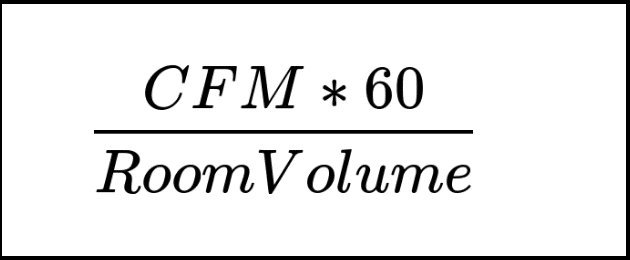
CFM – First, the volume of air in CFM (cubic feet per minute) currently delivered to the room in question by the building’s air handling unit or when evaluating an air purifier, the CFM of the unit with the air filters installed. 

ROOM VOLUME – Secondly, you will need to find the volume of the room in cubic feet, which is calculated by finding the height, length, and width of the room in feet and multiplying these numbers together.

From there, the calculation to find air changes per hour is simple:

  • Multiply the CFM by 60. This number will tell you how many cubic feet of air your device moves per hour. 
  • Divide the number you get by the room’s volume in cubic feet. You now have a number telling you how many times per hour the device moves the total volume of the room. This number is your air changes per hour, or ACH. 

Related video: What Size Air Cleaning Unit For Your Office? with Camfil’s Matthew Crouch 

ACH Example Calculation 

Let’s look at an example of this calculation in action. 

For this example, we’ll be calculating how many air changes per hour a premium air purifier can deliver in a classroom. 


An average U.S. elementary school classroom is recommended to be a minimum 900 square feet (2). In New Jersey, classrooms must have an average ceiling height of 9.5 feet (3). The volume of a classroom with these dimensions would be 8550 cubic feet. 

Camfil’s City M air purifier circulates air through its certified HEPA filters at 256 CFM. 


Therefore, ACH would be calculated as follows: 

The City M air purifier would deliver an additional 1.8 air changes per hour to a classroom with these dimensions.

ASHRAE recommends six air changes per hour for classrooms. Measuring the actual ACH delivered by the building’s HVAC system to individual classrooms may require an HVAC professional with airflow measurement equipment. Once you have that figure, it is a simple calculation to determine how many air purifiers are required to make up the difference and achieve the recommended ACH for the classroom. 

For guidance in determining the correct air filtration solutions for your situation, contact your local Camfil representative. 

About Camfil Clean Air Solutions 

For more than half a century, Camfil has been helping people breathe cleaner air. As a leading manufacturer of premium clean air solutions, we provide commercial and industrial systems for air filtration and air pollution control that improve worker and equipment productivity, minimize energy use, and benefit human health and the environment. We firmly believe that the best solutions for our customers are the best solutions for our planet, too. That’s why every step of the way – from design to delivery and across the product life cycle – we consider the impact of what we do on people and on the world around us. Through a fresh approach to problem-solving, innovative design, precise process control, and a strong customer focus we aim to conserve more, use less and find better ways – so we can all breathe easier.


The Camfil Group is headquartered in Stockholm, Sweden, and has 33​ manufacturing sites, six R&D centers, local sales offices in 30 countries, and about 4,80​0 employees and growing. We proudly serve and support customers in a wide variety of industries and in communities across the world. To discover how Camfil can help you to protect people, processes and the environment, visit us at www.camfil.com/en-us/. 


## 

Sources:

  1. https://www.epa.gov/report-environment/indoor-air-quality
  2. https://www.epa.gov/coronavirus/ventilation-and-coronavirus-covid-19
  3. https://www.scarsdaleschools.k12.ny.us/cms/lib/NY01001205/Centricity/Domain/1105/2014-11-19%20Meeting%20of%20Greenacres%20Building%20Committee%20Meeting%20Handout%203%20-%20Classroom%20Size%20Standards.pdf
  4. https://www.state.nj.us/education/code/current/title6a/chap13.pdf
  5. https://www.ashrae.org/file%20library/technical%20resources/covid-19/ashrae-reopening-schools-and-universities-c19-guidance.pdf

The post How to Calculate Air Changes Per Hour  appeared first on Air Filters for Clean Air.


from Air Filters for Clean Air