Wednesday, October 5, 2022

PM Checklist for HVAC System – Should You Extend the Time Between PM Service Calls?

Base PM schedule on equipment needs, not air filter changes.

Ask drivers how often they should change the oil in their cars and you’ll likely hear an answer that’s been repeated for generations: ‘three months or every 3,000 miles, whichever comes first.’ The performance of older automobile engines and the low quality of motor oil demanded a short interval be followed to avoid expensive repairs. However, that may no longer be valid as improvements to automotive engines and advancement in oil chemistry has changed the paradigm; saving many companies significant internal or external labor hours and cost.

Today, some synthetic oils  guarantee twenty-thousand miles between  changes, which, for the average American who drives 14,263 miles annually, means a once-per-year oil change. While car manufacturers are extending maintenance intervals up to 10,000 miles, and in some cases longer, that message has not yet reached everyone. Quick in-and-out oil change shops with guilt-inducing windshield stickers are doing their best to ensure the 3,000 mile/three-month oil change remains firmly in place, for obvious reasons.

But oil change intervals are not the only maintenance cycle under challenge due to advanced technology.  Recent improvements to HVAC equipment, building automation systems, and air filter technology have progressed to the point where the question should be asked: Is it also time to rethink the industry standard of automatically scheduling quarterly PM service calls on your HVAC equipment?

Let’s look at just a few recent technical innovations on three key components of HVAC systems and how they give you flexibility when determining the optimum interval between PM calls.

What Should Your PM Service Call Include? PM Checklist for HVAC System

In the commercial HVAC industry, “PM” stands for preventive maintenance. Just like getting an oil change for your car helps keep everything running smoothly and prevents engine trouble, a PM service will keep your HVAC system in good condition, preventing costly repairs and the downtime that accompanies them. 

While the exact steps that your HVAC maintenance expert should take will depend on the specifics of your HVAC system as well as the time of year, here is a general checklist for what a technician will do during a standard preventative maintenance call:

  • Replace filters on heating and/or cooling equipment.
  • Clear pans and drain lines.
  • Measure airflow to ensure it is adequate.
  • Replace any belts and pulleys found to be in poor condition.
  • Examine electrical connections. 
  • Clean evaporator and condenser coils. 
  • Lubricate moving parts such as gears and bearings. 
  • Ensure that controls, such as the thermostat, are working correctly.
  • Check and adjust fan and blower motor operation. 
  • Measure refrigerant charge and check for leaks if the charge is low. 

In short, a service contractor should be checking every component of your HVAC system to ensure that everything is running properly before any issues arise in its function. 

How Often Do You Really Need Preventative Maintenance for Your HVAC System?

  1. Modern HVAC equipment isn’t as prone to breaking. 


Like most mechanical systems, HVAC equipment has benefited from the improved reliability of raw materials in the supply chain. Stress fractures from the vibration of moving parts  are less of an issue as the consistency of metals and other materials used for structural supports have become more reliable. Belts, which in the past required regular inspections, now routinely run a minimum of one year between adjustments.


If we look at the heart of an HVAC system, new variable speed compressor technology reduces wear and tear by matching the compressor’s operational speed to the demand load. This also reduces repeated startups from a dead stop which is not only hard on equipment but requires significant energy.


If the compressor is the heart of the system, coils are the veins and arteries. Micro-channel coil technology, borrowed from the automotive industry, utilizes aluminum tubes as opposed to fins. These tubes are much sturdier with higher resistance to corrosion. The manufacturing technique used to produce these coils has fewer critical inherent failure points which further improves reliability.


  1. Automated monitoring systems allow remote inspection and adjustment. 


A maintenance office in today’s world may resemble an air traffic control tower due to the expanded use of building automation systems. It was not all that long ago, the ability to continuously monitor and adjust the performance of your HVAC equipment from a single computer terminal was limited to Fortune 500 companies with deep pockets. That is no longer the case as the widespread use of this technology has brought its benefits within nearly everyone’s budget.


These systems give the user the ability to monitor the current condition of multiple units with the same level of confidence as a visual inspection.  As software continuously improves, diagnostic functions and even equipment failure predictions will allow managers to avoid running equipment to failure between pre-scheduled maintenance calls.


  1. Higher-quality air filters protect HVAC equipment more effectively and for longer. 


The air filter is the final piece of the puzzle. More than the other two components, the service life of the pleated air filter has historically been the primary driver when developing a PM schedule. In the past, air filters would need to be replaced every three months. The lack of technical innovation to improve service life by air filter manufacturers coupled with service contractors who built their business models on four changes per year left the industry with their version of the “3000-mile oil change.”


However, according to Camfil USA’s Manager of Marketing and Technical Materials, Mark Davidson; “While today’s pleated air filters may look the same as they used to, the similarity ends there. Today, you can find structurally strong, moisture-resistant pleated filters with higher MERV ratings. It may be a surprise to many, but 12-month service life guarantees are now available”


“Be an active participant when selecting air filters that protect your people and your products. Everyone in the supply chain doesn’t have the same motives so it’s up to users to request test reports or modeling software projections. After purchase and installation, validate those lab reports with actual field testing to confirm performance.”


“Also, ask what guarantees are in place as far as how long the filter is expected to last,” says Davidson., “Take advantage of those filters capable of delivering higher performance combined with longer life because by doing that, PM schedules can now be developed after removing the service life of the air filter from the equation. In other words, create PM schedules based solely upon the needs and performance of HVAC equipment; not because an air filter needs to be changed.”


Based on the advancement in equipment performance, building controls, and air filter technology, should building managers rethink the practice of automatically scheduling quarterly PM service calls? It may be hard to say yes to that question, but remember that improvements in the auto industry successfully challenged something as deep-seated as the 3000-mile oil change, and we are all the better for it. The overall cost to the consumer is down, performance is up, and we are disposing  far less waste oil.


In the HVAC world, it seems technological improvements now allow PM schedules to be based primarily on the mechanical needs of the HVAC equipment and not because the air filters need changing. System performance is improved, overall costs are down, and far fewer dirty filters are shipped to landfills.

About Camfil Clean Air Solutions

For more than half a century, Camfil has been helping people breathe cleaner air. As a leading manufacturer of premium clean air solutions, we provide commercial and industrial systems for air filtration and air pollution control that improve worker and equipment productivity, minimize energy use, and benefit human health and the environment. We firmly believe that the best solutions for our customers are the best solutions for our planet, too. That’s why every step of the way – from design to delivery and across the product life cycle – we consider the impact of what we do on people and on the world around us. Through a fresh approach to problem-solving, innovative design, precise process control, and a strong customer focus we aim to conserve more, use less and find better ways – so we can all breathe easier.


The Camfil Group is headquartered in Stockholm, Sweden, and has 31​ manufacturing sites, six R&D centers, local sales offices in 35+ countries, and about 5,200 employees and growing. We proudly serve and support customers in a wide variety of industries and in communities across the world. To discover how Camfil USA can help you to protect people, processes and the environment, visit us at www.camfil.us/ 


##


Media Contact: 

Lynne Laake 

Camfil USA Air Filters 

T: 888.599.6620 

E: Lynne.Laake@camfil.com

F: Friend Camfil USA on Facebook

T: Follow Camfil USA on Twitter 

Y: Watch Camfil Videos on YouTube

L: Follow our LinkedIn Page


Sources:

https://www.fhwa.dot.gov/policyinformation/statistics/2019/vm202.cfm

https://cleanair.camfil.us/2017/09/21/extend-time-pm-service-calls/

The post PM Checklist for HVAC System – Should You Extend the Time Between PM Service Calls? appeared first on Air Filters for Clean Air.


from Air Filters for Clean Air

Friday, September 30, 2022

Interpreting Air Cleaner Performance Data by ASHRAE

Air purifiers have become permanent fixtures in homes, offices, retail stores, healthcare facilities and even industrial environments. As we enter the final stages of the pandemic; masks, lockdowns and crowd limitations are becoming less common, but the air purifier will likely remain.  

Demand for a product drives the supply chain to deliver. This demand / supply equation is often responsible for driving product innovation. With air purifiers, many innovations took the form of new, and in some cases, recycled technologies from the past, broadly categorized under the term electronic air cleaners. These products focus more on killing or inactivating viruses, bacteria and other organisms as opposed to particulate filters which capture and hold them within the body of an air filter. This kill or inactivate strategy was a response to the public’s demand to protect themselves against airborne infectious diseases like COVID-19.

The surge in demand for electronic air cleaners brought to light the fact consumers have a hard time finding simple methods or ratings systems to determine real world effectiveness. Particulate filters are evaluated and classified for particle capture efficiency using widely accepted test standards such as IEST-RP-CC001 or ISO 29463 for HEPA filters and ASHRAE 52.2 or ISO 16890 for HVAC style filters. Using particle capture efficiency together with a purifier’s airflow and size of the space in question, gives consumers the ability to better understand what an air purifier with a particulate air filter can, and just as importantly, cannot do. 

It’s not so simple with electronic air cleaners. A recent ASHRAE Journal article, Interpreting Air Cleaner Performance Data, details the difficulties in understanding the mechanics behind the various technologies and the ways they report efficacy. The concept of subtractive and additive mechanisms is discussed.  Subtractive is where particles are removed from the airstream as in a particulate filter. This is contrasted against additive technologies where something (chemically reactive compounds for example) are added to the space or airstream, either to improve the subtractive removal effectiveness or to change or inactivate the contaminant.

The article points out how the lack of performance test standards for electronic air cleaners leads to a variety of test reports that provide limited insight into product performance and safety. The most common standards used are two UL standards which deal exclusively with ozone emissions.

The article ends by providing a few thoughts on how useful test methods and standards could be developed in the future so consumers aren’t forced to rely on confusing marketing language often associated with electronic air cleaners. 

Industries often evolve due to market demands and if the pandemic drives the air purifier industry to include more electronic air cleaners, the questions about safety and real world performance expectations need to be answered so articles like this one aren’t necessary. 

Article available through ASHRAE.org. 


Source This article was published in ASHRAE Journal, April 2022. Copyright 2022 ASHRAE. Posted at https://bit.ly/3E6qA56. This article may not be copied and/or distributed electronically or in paper form without permission of ASHRAE. For more information about ASHRAE Journal, visit https://bit.ly/3E6qA56.

https://bit.ly/3E1oKTg

The post Interpreting Air Cleaner Performance Data by ASHRAE appeared first on Air Filters for Clean Air.


from Air Filters for Clean Air
Saturday, September 24, 2022

How to Prepare for Flu Season with Air Filters in 2022

With the weather beginning to cool down in many parts of the United States, influenza and other respiratory infections will soon begin to circulate. In some places, including Texas, Delaware, Georgia, and New Mexico, rates of flu infection are already beginning to climb. In this article, air quality experts from Camfil explain how air filters and air purifiers can help prevent the spread of the flu this fall and winter. 

Why Do We Get Sick More in the Winter?

Health experts speculate that many factors contribute to increased respiratory and other infections in the fall and winter, including:

  • There are a range of pathogens that reproduce more effectively in cooler temperatures. 
  • Our immune systems are often less effective during the winter. When our body is preoccupied with more essential functions, such as maintaining an adequate internal temperature, less urgent bodily functions such as the immune system take the backseat, leaving us more vulnerable to viruses and bacteria when we come into contact with them.
  • When the weather is colder, people are more likely to congregate in both large and small groups indoors for extended periods of time. 

People are likely to spend more time in confined indoor spaces when the weather is colder, which increases the likelihood of encountering pathogens in the air. 

Related Article: Why Do We Get Sick More In Cooler Months

How Is the Flu Transmitted? 

According to the CDC, influenza spreads via airborne transmission routes, as explained below:

“People with flu can spread it to others up to about 6 feet away. Most experts think that flu viruses spread mainly by droplets made when people with flu cough, sneeze or talk. These droplets can land in the mouths or noses of people who are nearby or possibly be inhaled into the lungs. Less often, a person might get flu by touching a surface or object that has flu virus on it and then touching their own mouth, nose, or possibly their eyes.”

— Source: CDC Website

When Is Flu Season 2022?

The exact timing of the circulation of flu viruses is difficult to predict and may vary regionally, but flu activity usually begins to increase in October, and cases peak between December and February.

Just as doctors recommend flu vaccinations be given in September and October for those who choose to take them, it is best to take precautionary measures against the spread of the flu ahead of time. 

How Do Air Purifiers Help Prevent Flu?

Air purifiers can help prevent the spread of the flu in two main ways:

  1. By increasing ventilation. Poor ventilation allows infected particles and other contaminants to build up in indoor air, leading to an increased likelihood of inhabitants inhaling an infected respiratory droplet or nuclei and contracting an infection themselves. 
  2. By removing contaminants from the air. Simply recirculating indoor air through a building’s HVAC system to increase ventilation may not  adequately protect its inhabitants from pathogens because the system’s air filters are not likely to have a high enough capture efficiency, ie. MERV value.. The air must be filtered to remove infected respiratory droplets. An H14 HEPA filter, if tested and certified as such, is rated to remove 99.995% of the smallest particles in the air, including viruses. 

A medical-grade air purifier such as the City M Air Purifier by Camfil uses Absolute HEPA technology to remove pathogens from the air, in addition to other harmful particles such as dust, contaminants, and allergens. The Absolute HEPAs in the City M are tested and certified to be H14 filters. The City M is also equipped with a molecular filter to remove harmful gases, such as volatile organic compounds, from the air. Delivering 256 cubic feet of clean air per minute, the City M is a standalone unit that acts independently of the building’s HVAC system and offers excellent ventilation in addition to HEPA filtration. 

Find out the best air filtration solutions for your building this flu season by consulting your local Camfil representative

About Camfil Clean Air Solutions

For more than half a century, Camfil has been helping people breathe cleaner air. As a leading manufacturer of premium clean air solutions, we provide commercial and industrial systems for air filtration and air pollution control that improve worker and equipment productivity, minimize energy use, and benefit human health and the environment. We firmly believe that the best solutions for our customers are the best solutions for our planet, too. That’s why every step of the way – from design to delivery and across the product life cycle – we consider the impact of what we do on people and on the world around us. Through a fresh approach to problem-solving, innovative design, precise process control, and a strong customer focus we aim to conserve more, use less and find better ways – so we can all breathe easier.

The Camfil Group is headquartered in Stockholm, Sweden, and has 31​ manufacturing sites, six R&D centers, local sales offices in 35+ countries, and about 5,200 employees and growing. We proudly serve and support customers in a wide variety of industries and in communities across the world. To discover how Camfil USA can help you to protect people, processes and the environment, visit us at www.camfil.us/ 


##


Media Contact: 

Lynne Laake 

Camfil USA Air Filters 

T: 888.599.6620 

E: Lynne.Laake@camfil.com

F: Friend Camfil USA on Facebook

T: Follow Camfil USA on Twitter 

Y: Watch Camfil Videos on YouTube

L: Follow our LinkedIn Page


Sources:

  1. https://nyti.ms/3St3zgO 
  2. https://bit.ly/3SrTXn7 
  3. https://bit.ly/3SsK2gz 

The post How to Prepare for Flu Season with Air Filters in 2022 appeared first on Air Filters for Clean Air.


from Air Filters for Clean Air
Sunday, September 4, 2022

How to Improve Indoor Air Quality in Areas Affected by Wildfires

How to Improve Indoor Air Quality in Areas Affected by Wildfires

Wildfires are usually at their peak July through October. This year is no exception. More than 5.7 million acres of woodland have already burned according to the National Centers for Environmental Information[1] (NCEI)’s Interagency Fire Center – the third most in recorded history. Summer droughts, reduced mountaintop snowpack and lightning strikes have doubled the area of wildfires in the western U.S.

Does wildfire smoke affect air quality?

Yes. Wildfires cause poor air quality, which affects the health of people both indoors and outside. This is because wildfires produce tiny dangerous airborne particles and gaseous contaminants regulated by the EPA’s National Ambient Air Quality Standards (Clean Air Act)[ii].

When wildfire smoke is drawn into a building through an HVAC system without proper filtration, the contaminants can spread throughout the facility, causing poor air quality conditions. Patients and visitors in hospitals, outpatient or residential care facilities are especially vulnerable to these contaminants.

Why wildfire smoke is a health concern

Breathing wildfire smoke is bad for the body. PM2.5 contaminants (particles smaller than 2.5 microns) can penetrate deep into the lungs and bloodstream. Molecules of gases like ozone are thousands of times smaller than PM2.5 particles, and are able to enter the body’s cells and major organs, causing irreversible damage.

Exposure to pollutants from wildfire smoke increases the likelihood of contracting and experiencing severe complications. PM2.5 and gaseous contaminants cause a range of health problems from temporary burning eyes to lifelong heart and lung damage. That is why the EPA refers to ozone as “sunburn for the lungs.”[iii]

Programs such as the Interagency Wildfire Air Quality Response Program were created to directly assess, communicate, and address risks posed by wildland fire smoke to public health [iv]. However, the most important tool to gauge exposure risk is the Air Quality Index (AQI).

What is the Air Quality Index?

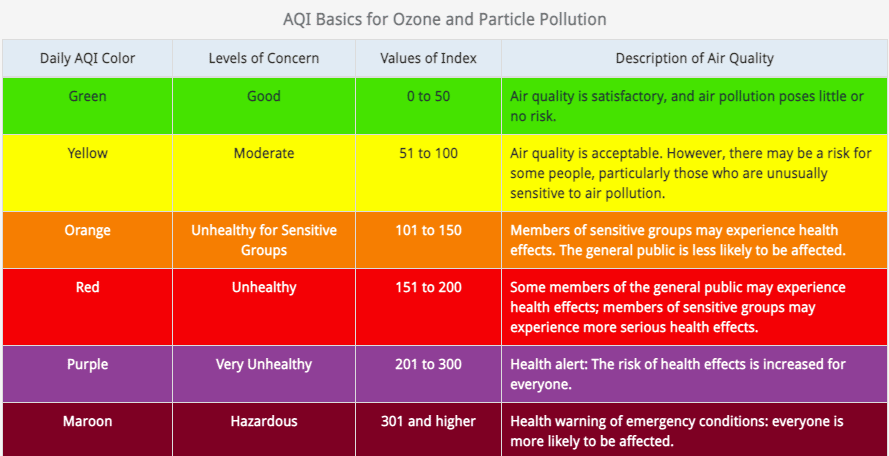
The EPA created the AQI to help measure the level of pollutants in the air at any given time for each area of the United States. This index is now used around the world, with readings measured at every airport. Think of the AQI as a yardstick that runs from 0 to 500. The higher the AQI value, the greater the level of air pollution and the greater the potential health impact.

The AQI is divided into six categories. Each category corresponds to a different level of health concern. Each category also has a specific color. The color makes it easy for people to quickly determine whether air quality is reaching unhealthy levels in their communities.[v]  Green (<50) and yellow (51-100) are acceptable, orange (101-150)  means sensitive people may be affected, red (151-200) and purple (201-300) are enough cause for alarm that people should stay inside, and maroon (above 301) means emergency conditions are present.


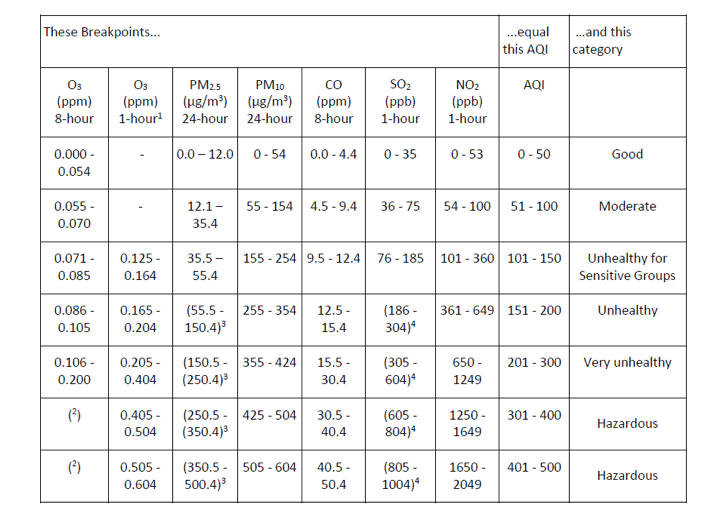
To generate the AQI, the EPA measures the level of criteria air pollutants from the Clean Air Act – ground-level ozone, PM2.5, carbon monoxide, sulfur dioxide (SO2 ) and nitrogen dioxide (NO2) Gases are measured in parts per billion and particulates are measured in micrograms (µg) per cubic meter.

The EPA crunches all of these readings into a formula in order to generate the one AQI number that is reported on the above chart. Most sites like purpleair.com and airnow.gov will also tell you which component is causing the number to be high.

How wildfires affect AQI

Wildfire smoke contains pollutants because it is produced by the combustion of organic and other substances. The smoke contains microscopic particles less than 2.5 microns in size, known as PM2.5. In fact, 90% of the total mass of wildfire smoke is comprised of these particles and they are the largest contributor to a poor AQI number. Particles generally 2.5 µm in diameter or smaller represent a main pollutant emitted from wildfire smoke, comprising approximately 90% of total particle mass.[vi]

Wildfires also release gaseous hydrocarbons and nitrogen oxides that form nuisance odors and ground-level ozone. Ground-level ozone is created when UV light from the sun reacts with gases near the earth’s surface. Secondary contaminants from wildfires include:

  •   Nitrogen Oxides
  •   Sulfur oxides
  •   Carbon monoxide
  •   Unburned hydrocarbons
  •   Volatile organic compounds

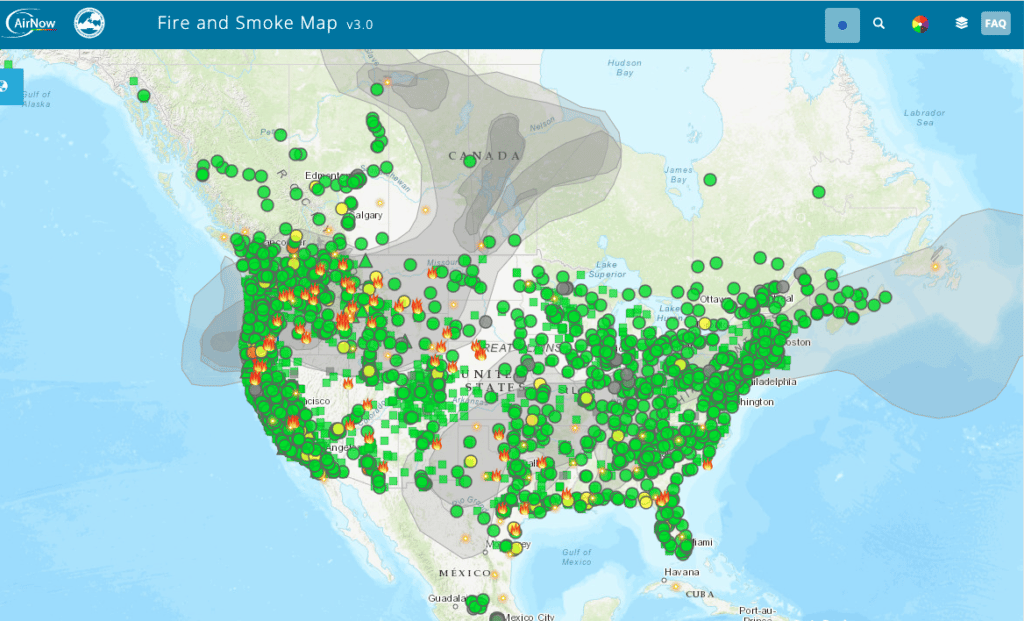
The map below from AirNow.gov shows fire and smoke occurrences from August 8, 2022.  Smoke can be carried on air currents to populated areas miles away from the actual fire. People in the midwest and east are not immune from the effects of fires burning hundreds of miles to the west or south.  All of these contaminants can enter indoor spaces, causing poor indoor air quality for workers and visitors to facilities. It is typically a facility manager’s job to figure out how to reduce wildfire smoke exposure for employees and visitors to the buildings.


Filtering Wildfire Smoke (Cleaning the Air)

When considering wildfire smoke, the particulate matter is the first area to address with filtration. The PM2.5 particles need to be captured because those are what causes the greatest health problems. In addition, if the facility’s location is close to the source of the fire, there can be high levels of ozone gases and nuisance odors. In those cases, the gases need to be captured along with the particles. Even if the dangerous particles are captured, people don’t want to work or visit facilities that smell like smoke.

To mitigate the risks and nuisance of wildfire smoke, Camfil recommends using a combination of high efficiency air filters to capture PM2.5 particles and carbon filtration to control odor and gaseous contaminants.

Capturing PM2.5 Particulates

We recommend using a filter that will catch at least 90% of the PM2.5 particles. That means the filter should have a minimum efficiency reporting value (MERV) of at least 14A.

The “A” rating is important because it verifies the filters were tested according to ASHRAE Standard 52.2-2017 with Appendix J to test the efficiency after any electrostatic charge has been discharged.  This test shows what the  efficiency is over the entire lifetime of the filter, not just in the first few weeks. .

Capturing gases

Capturing the gases contained in smoke requires molecular filtration because the molecules are too tiny to be captured by particulate  filters. For example, a .3 micron-sized solid particle would contain 1000 ozone molecules.  Molecular filters use granulated carbon, which contain a vast network of pores to provide a huge surface area to collect the gas molecules as they make contact. . The molecules attach themselves to the surface of the pores by light intermolecular forces. This process is known as adsorption.

When selecting molecular filters, make sure your filter was tested to ISO 10121 (or ASHRAE 145.2) to validate its performance under actual process conditions. Since there are over 250 million chemicals that all behave differently, there is no molecular filter classification system like ASHRAE’s  MERV valueThe only way to know for certain how the filter will work is to test it using the actual chemical and process conditions.

Camfil uses its ISO 10121 test rig in Trosa, Sweden and Ipoh, Malaysia to test gases at the correct concentrations, temperature and relative humidity level. The air is measured upstream and downstream to gauge performance. This validation testing can make a significant difference in actual use for two filters that claim the same efficiency. For example, Camfil’s MERV 14A particulate filters with a carbon layer maintain their 95% efficiency performance against ozone versus competitive filters that drop efficiency to 70% almost immediately.

Installing Filtration to Mitigate Wildfire Smoke

Camfil recommends installing 12” deep MERV 14A filters for PM2.5 and 12” high- capacity carbon filters for gas removal. If there are two filter banks, a Durafil MERV14A followed by a CitySorb DP (carbon)  molecular filter is recommended. If there is only one filter bank, the facility should use a CityCarb I combination MERV 14A plus molecular (carbon) filter. ISO tests demonstrate that the CitySorb DP and  Camfil CityCarb I filter have superior performance against ozone, nitrogen dioxide,  sulfur dioxide and toluene which is used to represent smoke odors.  Camfil encourages engineers to design tomorrow’s systems with two banks so that each filter can be utilized for its full lifetime.

Facilities can also use supplemental filtration indoors when wildfires are present. These air cleaners like the City M with HEPA and molecular filters and  modular CamCleaner systems are commonly used in hospital waiting rooms, universities, offices, etc. to supplement the amount of air scrubbing in a space.

About Camfil Clean Air Solutions

For more than half a century, Camfil has been helping people breathe cleaner air. As a leading manufacturer of premium clean air solutions, we provide commercial and industrial systems for air filtration and air pollution control that improve worker and equipment productivity, minimize energy use, and benefit human health and the environment. We firmly believe that the best solutions for our customers are the best solutions for our planet, too. That’s why every step of the way – from design to delivery and across the product life cycle – we consider the impact of what we do on people and on the world around us. Through a fresh approach to problem-solving, innovative design, precise process control, and a strong customer focus we aim to conserve more, use less and find better ways – so we can all breathe easier.

The Camfil Group is headquartered in Stockholm, Sweden, and has 31 ​manufacturing sites, six R&D centers, local sales offices in 35+ countries, and about 5,200 employees and growing. We proudly serve and support customers in a wide variety of industries and in communities across the world. To discover how Camfil USA can help you to protect people, processes and the environment, visit us at www.camfil.us/.


[i]https://www.ncei.noaa.gov/access/monitoring/monthly-report/fire/202207


[ii] https://www.epa.gov/clean-air-act-overview


[iii]chrome-extension://efaidnbmnnnibpcajpcglclefindmkaj/https://bit.ly/3wVjg8b


[iv] https://www.wildlandfiresmoke.net/


[iv] https://www.airnow.gov/aqi/aqi-basics/


[v] Vicente et al. 2013; Groβ et al. 2013). (epa.gov)


The post How to Improve Indoor Air Quality in Areas Affected by Wildfires appeared first on Air Filters for Clean Air.


from Air Filters for Clean Air
Wednesday, August 10, 2022

Back to School: Why Schools Need Air Filtration to Protect Students

As students return to school for a new school year in many states, it is essential for school districts to consider the effects of air pollution on students and implement strategies to mitigate these effects.

How Does Poor Indoor Air Quality (IAQ) Affect Children in Schools?

Productivity: Better Air Quality Improves Learning and Cognition

Teachers make a variety of efforts to maximize the effectiveness of their students’ learning experience; customized teaching strategies, optimized classroom layouts, and detailed lesson plans are just a few of the factors that teachers consider. 

But a crucial factor in a student’s success is the air they breathe. Research has demonstrated the effects of air quality on several key aspects of cognition. 

In a 2016 study, researchers tested how air quality affected the cognitive performance of office workers. Study participants spent six full work days (eight hours) in environmentally-controlled office spaces, blind to test conditions. On each of the days, they were exposed to different levels of pollutants (VOCs and CO2), and the spaces were ventilated at a different rate. 

Of the nine domains of cognitive function tested, researchers found that all were improved by higher air quality. Cognitive scores averaged 61% higher on days with better air quality and 101% higher on days with both better air quality and improved ventilation than on days that represented typical office air quality conditions. 

Sharp cognitive function is especially important for children, as it is necessary for developing critical thinking skills, absorbing information, and learning problem-solving.  

Read more about the link between air quality and productivity here. 

Attendance: Poor Air Quality Linked to More School Absences

Obviously, students will bear the brunt of air pollution exposure. In fact, a recent study conducted by researchers from the University of Utah reveals that the number of school absences usually doubles the day after a red air day—that’s when ambient or outdoor air quality levels have reached unhealthy levels. 

The study, which analyzed student attendance data from the Salt Lake City School District, found that even a slight increase in PM2.5—particulate matter no larger than 2.5 microns in diameter, also known as fine particulate matter—led to a substantial increase in the number of student absences the following day. 

A 2019 study by a team of researchers at the University of Utah who analyzed data from the Salt Lake City School District found that school absences doubled the day immediately following a red air day (when local air quality data indicates that ambient outdoor air quality has reached unhealthy levels). The researchers also found that even small increases in fine particulate matter (PM2.5) led to significant increases in student absences the following day.

Read more about the effects of air pollution on school attendance.

Health: Air Pollution Linked to Poor Health Outcomes, Including Childhood Obesity

In addition to the widely known effects of air pollution on respiratory and cardiovascular health, both in the short- and long-term, poor air quality has a wide range of serious, and sometimes unexpected, health outcomes. These outcomes are particularly prevalent among children and teenagers. 

Many studies have documented the link between symptoms of asthma and childhood obesity. A 2015 study published in the American Journal of Respiratory and Critical Care Medicine, for example, found that asthmatic children were 51% more likely than their peers to become obese over the next decade. 

Researchers hypothesize that the pain and discomfort caused by asthma cause children affected by the condition to play and exercise less, leading to weight gain. The presence of common pollutants in schools, including pollen, dust, and volatile organic compounds (VOCs) worsens symptoms of asthma and triggers full-blown asthma attacks. With over six million American children affected by asthma, it is important for the air inside schools to be clean. 

Read more about the link between air quality and weight gain here. 

Sickness: Air Filtration Reduces the Spread of COVID-19 and Other Illnesses 

The spread of COVID-19 in schools is still a major concern due to the close proximity of children to each other. COVID-19 is one of many illnesses that spreads via airborne respiratory droplets from infected individuals. Because these respiratory droplets are considered particulate matter, they can be filtered out of the air just like any other particle pollutants of similar size. 

As new, more contagious variants continue to emerge, it is important to reduce the spread of infections within schools to avoid widespread infections and potential school shutdowns. 

Premium Air Filters to Protect Students and Improve Learning for 2022 Fall Semester

Fortunately, poor indoor air quality in schools can be controlled through the use of high-efficiency air filters in the HVAC systems of schools where possible. In the many cases that the school’s HVAC system is not equipped to handle high-efficiency filters, standalone air purifiers, such as Camfil’s City M can be used. This provides the added benefit of removing gaseous pollutants, such as carbon dioxide and VOCs, from the air. 

Read this case study to learn about how Camfil worked with a Mid-Atlantic school district to optimize air quality and protect students’ health. 

About Camfil Clean Air Solutions

For more than half a century, Camfil has been helping people breathe cleaner air. As a leading manufacturer of premium clean air solutions, we provide commercial and industrial systems for air filtration and air pollution control that improve worker and equipment productivity, minimize energy use, and benefit human health and the environment. We firmly believe that the best solutions for our customers are the best solutions for our planet, too. That’s why every step of the way – from design to delivery and across the product life cycle – we consider the impact of what we do on people and on the world around us. Through a fresh approach to problem-solving, innovative design, precise process control, and a strong customer focus we aim to conserve more, use less and find better ways – so we can all breathe easier.

The Camfil Group is headquartered in Stockholm, Sweden, and has 31​ manufacturing sites, six R&D centers, local sales offices in 35+ countries, and about 5,200 employees and growing. We proudly serve and support customers in a wide variety of industries and in communities across the world. To discover how Camfil USA can help you to protect people, processes and the environment, visit us at www.camfil.us/ 


##


Media Contact: 

Lynne Laake 

Camfil USA Air Filters 

T: 888.599.6620 

E: Lynne.Laake@camfil.com

F: Friend Camfil USA on Facebook

T: Follow Camfil USA on Twitter 

The post Back to School: Why Schools Need Air Filtration to Protect Students appeared first on Air Filters for Clean Air.


from Air Filters for Clean Air

Monday, August 8, 2022

Updated: Camfil’s New CamExtend Offers Better Air Filtration that Pays for Itself

Updated: This new add-on is a simple device that is easy to install and provides more options when selecting HVAC replacement air filters in space-limited situations.

Camfil announces its new CamExtend product, which installs as an add-on to existing HVAC filter bank holding frames, providing the end user an additional ten inches of filter depth allowing the energy savings installation of deep pocket, Hi-Flo® ES filters with the performance guarantees that come with it. Because of lower total operating costs, the small investment in a CamExtend will pay for itself in short order, saving hundreds of dollars over a five year time frame, depending on the installation.
This unique design of the sixteen gauge galvanized steel frame gives cost and energy conscious facilities more options for selecting high performance air filter products. No longer locked into using shorter depth bag filters or compact box style products, the CamExtend opens up the benefits of the 22″ deep, and in some cases the 30″ deep Hi-Flo ES to those with air handling units with limited inline depth.

>> Download CamExtend see product sheet here

  • The 22″ or 30″ Hi-Flo ES offers a longer life and increased energy savings,
  • Less waste and labor saved because of fewer filter replacements,
  • No more clips or fasteners,
  • 40% reduction in the time it takes to replace filters, and
  • In some applications, the prefilter can be completely eliminated.

The CamExtend is easy to assemble and attaches into any front load HVAC filter bank, like a traditional double-header box style filter would fit. Once installed, there’s no need to change or remove the product again.

The CamExtend accepts specially designed Hi-Flo ES filters constructed with a full perimeter, SnapSeal® magnetic gasket. This combination provides significant savings in energy costs and eliminates the hassles of using clips and fasteners.

  • This seals the entire perimeter of the filter flat against the inner flange of the CamExtend eliminating air bypass around the filter so all the air is filtered, and
  • There are no fasteners or clips for any future filter installations.

For more details, on the CamExtend, see product sheet

The world leader in air filtration systems, Camfil provides clean air solutions for hospitals, hotels, office buildings, educational institutions, and pharmaceutical and biotech companies. We provide the tools to achieve sustainability, maintain high air quality, and reduce airborne infections — all while lowering total cost of ownership. Camfil customers go green without ever sacrificing performance. For more information, visit us online at www.camfil.us, or call us toll-free at 888.599.6620.

Media Contact:

Lynne Laake
888-599-6620
Lynne.Laake@camfil.com

The post Updated: Camfil’s New CamExtend Offers Better Air Filtration that Pays for Itself appeared first on Air Filters for Clean Air.


from Air Filters for Clean Air

Thursday, August 4, 2022

Air Pollution Levels Peak in the Summer: Air Filtration Experts Explain Why Air Quality Is So Bad During the Summer 

In many locations across the United States and across the world, air quality is at its worst during the summer months. In this article, air pollution experts from global air filtration industry leader Camfil discuss the factors that lead to higher levels of pollution in the summer. 

Arid Summer Weather Conditions Increase Particulate Matter

A combination of weather-related factors increase levels of particulate matter in the air in certain areas. Most notably, an extended period of time with no precipitation causes dirt, sand, and soil in the ground to become loose and dry, as opposed to its more stable, compact form during other seasons. As a result, the loosened ground is easier to disperse via the wind, as well as the wheels of vehicles and foot traffic, sometimes as much as doubling concentrations of particulate matter in the area.

Additionally, hot, sunny conditions facilitate the formation of ground-level ozone most efficiently. Although this effect is somewhat mitigated by humidity in some places, dry areas are especially at risk of experiencing increased ozone levels during the summer. 

Wildfires Release Pollutants Far and Wide

Over the past several years, wildfires have been increasing in both scope and severity across the world. During June through August, wildfires are at their peak. Wildfire smoke contains a range of pollutants — both particulate and gaseous — that affect air quality not only in the immediate radius of the wildfire but also in areas thousands of miles away due to the ability for the wind to disperse wildfire smoke in all directions, causing hazy skies and poor air quality in areas far from the site of the wildfire. 

Related: How to Protect Your Lungs During Wildfire Season, According to Camfil Air Quality Experts 

Summertime Activities Release Pollutants

With children on summer break, the volume of people traveling for vacations is at its highest over the summer. Increased air and road travel and the increased release of exhaust that comes along with it lead to higher levels of ambient air pollution. Furthermore, popular summer activities such as lighting bonfires and setting off fireworks reduces overall air quality. 

Summer Thunderstorms Increase Presence of Pollen

Although spring rain clears pollen from the air, the conditions in a summer thunderstorm cause a unique distribution of pollen and plant spores that have been known to trigger asthma attacks. This phenomenon — which has occurred in widespread waves in Australia, England, and Italy, but is known to occur in isolated incidences in other places — was a mystery to experts and researchers for decades. 

However, a recent study published in the Journal of Applied Meteorology and Climatology examined a wave of “thunderstorm asthma” that occurred in Melbourne in 2016, resulting in over 8000 hospitalizations and 8 deaths. The researchers found that specific patterns of airflow, compounded by the humidity and static electricity in the air associated with summer storms, were likely responsible for the hazardous conditions. Downdrafts of cold air that form inside a thunderstorm work to concentrate pollen, mold spores, and other allergens, and then carry them into the clouds. The high humidity, windy conditions, and sometimes even lightning in the clouds rupture these particles and break them down into much smaller fragments that can bypass our bodies’ natural barriers and enter the lungs directly through the nose. Furthermore, windy conditions redistribute these dangerous particles around the area of the storm, leading to a larger radius of potential damage.

Air Conditioning Without Adequate Filtration Recirculates Pollutants 

In most of the United States, where summer temperatures often soar over one hundred degrees, we would be very uncomfortable without using air conditioning in our homes and public spaces. At least 90% of American homes have some form of air conditioning, and 60% of those homes use a central air conditioning system. 

Most central air conditioning systems are equipped with panel filters that are sufficient to protect the equipment from being damaged by large particles but do not protect building inhabitants from finer pollutants. As a result, HVAC systems may repeatedly recirculate polluted air while also bringing polluted outdoor air into the airstream. 

To find the best air filtration solution to prevent your air conditioning from harming your lungs, discuss your options with your local Camfil representative.

About Camfil Clean Air Solutions

For more than half a century, Camfil has been helping people breathe cleaner air. As a leading manufacturer of premium clean air solutions, we provide commercial and industrial systems for air filtration and air pollution control that improve worker and equipment productivity, minimize energy use, and benefit human health and the environment. We firmly believe that the best solutions for our customers are the best solutions for our planet, too. That’s why every step of the way – from design to delivery and across the product life cycle – we consider the impact of what we do on people and on the world around us. Through a fresh approach to problem-solving, innovative design, precise process control, and a strong customer focus we aim to conserve more, use less and find better ways – so we can all breathe easier.

The Camfil Group is headquartered in Stockholm, Sweden, and has 31​ manufacturing sites, six R&D centers, local sales offices in 35+ countries, and about 5,200 employees and growing. We proudly serve and support customers in a wide variety of industries and in communities across the world. To discover how Camfil USA can help you to protect people, processes and the environment, visit us at www.camfil.us/ 


##


Media Contact: 

Lynne Laake 

Camfil USA Air Filters 

T: 888.599.6620 

E: Lynne.Laake@camfil.com

F: Friend Camfil USA on Facebook

T: Follow Camfil USA on Twitter 

Y: Watch Camfil Videos on YouTube

L: Follow our LinkedIn Page


Sources:

  1. https://scied.ucar.edu/learning-zone/air-quality/how-weather-affects-air-quality
  2. https://www.lung.org/blog/can-a-thunderstorm-trigger-asthma 
  3. https://www.bloomberg.com/news/articles/2019-07-10/why-we-always-fight-over-air-conditioning
  4. https://journals.ametsoc.org/view/journals/apme/56/5/jamc-d-17-0027.1.xml


The post Air Pollution Levels Peak in the Summer: Air Filtration Experts Explain Why Air Quality Is So Bad During the Summer  appeared first on Air Filters for Clean Air.


from Air Filters for Clean Air