Monday, June 29, 2020

Camfil New Product Launch for COVID-19 – Introducing CC500 Portable Air Purifier Lowering the Risks of Harmful Viruses and Pathogens

“With newly spiking numbers of COVID-19 cases across the country, the need for negatively pressurized isolation areas is on the rise.  The value of portable air purifiers is almost impossible to overstate in the circumstances we find ourselves in today. In response to growing demand, Camfil announces the new CamCleaner CC500.” Keith Woolard, Product Manager – Containment and CamCleaners

Riverdale, NJ — The launch of a new portable air purifier by Camfil continues its promise “Clean Air A Human Right.”

Camfil delivers the products needed for critical applications, such as COVID-19 treatment. The CamCleaner CC500 functions as both a portable air purifier or ducted negative air system for creating isolation areas.  Some of the salient features include: 
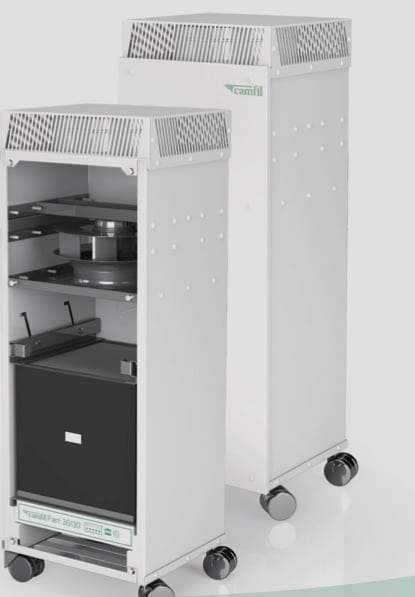
CamCleaner CC500 can be used as a room air purifier or installed to create negatively pressurized isolation areas.

Features of the CamCleaner CC500:

  • 99.99% true HEPA (high-efficiency particulate air) filter
  • Camfil 30/30® Dual 9 prefilter, to extend the life of the HEPA filter
  • Easy access filter replacement
  • 34″ tall x 12.5″ wide by 14″ deep to fit into most spaces
  • Weighs just 50 lbs, including filters, for manageable transportation
  • Silent roll caster wheels  or available with a mounting kit for wall- or ceiling-mount
  • Hospital-grade cord set plugs into any standard 120-volt three-prong electrical outlet 
  • Delivers up to 12 air changes per hour (ACH) in 2500ft3 as an in-room HEPA air purifier
  • Bottom air intake with purified air exhausted through slotted vent cap or optional duct

What can the CamCleaner CC500 be used for? 

With HEPA filters thoroughly tested to a minimum of 99.99% efficient, and a 5-star MERV 9A prefilter, the CamCleaner CC500 can be used as a portable air purifier or as a ducted negative air system to protect patients, staff and visitors from airborne viruses, pathogens, and harmful particles. It can be put to use in: 

  • Patient/resident rooms
  • Procedure rooms
  • Isolation rooms
  • Doctor and Dentist offices
  • Hospital visitation  areas
  • Retail space
  • Offices
  • Classrooms
  • Gathering areas

The CC500 Solves Problems for Healthcare Facilities

Because COVID-19 spreads primarily through respiratory droplets, hospitals face a unique issue when treating infected patients. The air in COVID treatment areas should be kept separate from the air in other hospital areas so that infected air droplets don’t escape into uninfected areas. Because air flows from higher pressure zones to lower pressure zones, negative pressurization is commonly used to control the spread of airborne diseases in hospitals. When the air pressure in an isolation area is “negative,” it’s lower than the air pressure of surrounding areas, which means that outside air can flow into the area, but not out. This helps prevent infections from spreading but introduces a need for high-efficiency filtration within the area because of the lack of airflow. 

COVID-19 Spiking Numbers 

With newly spiking numbers of COVID-19 cases across the country, the need for isolation areas is on the rise. Because it is lightweight and portable, the CamCleaner CC500 allows healthcare facilities to quickly establish new isolation rooms if needed.  When installed as a room air purifier, the  CC500  keeps the air clean because of its HEPA filter and MERV-9A prefilter. Because one unit can accomplish both functions, it significantly reduces costs for the end-user. 

About Camfil 

Camfil is driven by the mission that clean air is a human right. In the midst of the COVID-19 pandemic, Camfil has been at the forefront of air filtration research and engineering to protect uninfected individuals by keeping the air clean. To find the air filtration solution that best addresses your needs and goals, contact Camfil today

###


Media Contact: 

Lynne Laake 

Camfil USA Air Filters 

T: 888.599.6620 

E: Lynne.Laake@camfil.com

F: Friend  Camfil USA on Facebook

T: Follow Camfil USA on Twitter 

Y: Watch Camfil Videos on YouTube

L: Follow our LinkedIn Page  


The post Camfil New Product Launch for COVID-19 – Introducing CC500 Portable Air Purifier Lowering the Risks of Harmful Viruses and Pathogens appeared first on Air Filters for Clean Air.


from Air Filters for Clean Air

Wednesday, June 24, 2020

How High-Efficiency Camfil Air Filters Improve Workplace Productivity

Learn how the ability of high-efficiency air filters improve indoor air quality in the office and can maximize employee productivity. 

Air pollution is often thought of only in terms of the air we breathe outdoors, but indoor air pollution is just as harmful.  The air inside the workplace may be affecting employees in more ways than one. Commercial office buildings, retail spaces and industrial facilities need to review and perhaps upgrade to high-efficiency air filters.  

Indoor air pollution in the office can be caused by spaces such as conference rooms, offices and corridors being kept shut   year-round. Some buildings were designed so windows could not be opened in order to lessen energy usage.  

But sealing a building can have unintended consequences.

For starters, it means that every breath exhaled by employees during long office hours raises carbon dioxide levels in the room which has the potential to cause headaches and drowsiness. It also means that VOCs and PM (volatile organic compounds and particulate matter)  from office equipment, industrial processes, and cleaning solvents continuously accumulate in the building. 

The Dangers of Poor Indoor Air Quality in Offices

While the health risks of poor outdoor air quality are well-known—air pollution is linked to upper respiratory tract infections, asthma, lung cancer, and chronic obstructive pulmonary disease (COPD) — the effects of poor indoor air quality are just as bad, if not worse.

“Studies show that good indoor air quality has a positive effect on people’s productivity,” explains Mark Davidson, Manager of Marketing and Technical Materials at Camfil USA. “They’re more alert. They show better cognitive performance thanks to improved oxygen flow. And they can even gain better general health. This translates into fewer sick days and improved well-being.”

Ventilation with High-Efficiency Air Filters Needed

Natural ventilation with fresh outside air would certainly help to alleviate the problem, but as mentioned, many buildings are not designed with windows that open. Also, many retail or industrial facilities have safety and comfort issues that limit the use of outdoor air. Opening a window would have little impact on air quality in the middle of a large industrial facility or for an interior store in a retail mall.  

The role of an HVAC system is to circulate air which has been conditioned (heated or cooled) and filtered in order to provide a comfortable and safe indoor environment. When an HVAC system is outfitted with high-efficiency air filters, the quality of the indoor air can make a noticeable difference to the building’s occupants. 

 The Cost of Ignoring Indoor Air Quality is Not Just Financial

According to the United States Environmental Protection Agency (EPA), indoor air pollution tends to be two to five times worse than outdoor air pollution—at its most extreme, air quality can be up to 100 times worse than open-air environments. This is precisely what makes high-efficiency air filters so important in commercial office buildings, retail spaces and industrial facilities.

The problem of indoor air pollution has become so bad that, according to The Lancet, hundreds of thousands die each year due to poor air quality in workplaces. People can also develop symptoms of “sick building syndrome,” a condition characterized by migraines, breathing problems, and loss of productivity, caused by indoor air pollution exposure.

Choosing  Air Filters for Office Spaces

For offices struggling with poor indoor air quality, high-efficiency air filters offer a solution allowing you to maintain the safety and cleanliness of your air, ensuring that workers stay healthy and productive. These filters offer an efficient way to protect employees from breathing in airborne pollutants from indoor sources, such as:

  •       Raw materials
  •       Chemicals
  •       Activities such as cooking, heating, and lighting

Work with Trusted Commercial Air Filter Manufacturers

Because no two workplaces are the same, it’s important to procure the appropriate air filter system for your company’s needs. This is where reliable air filter manufacturers come in as they can recommend air filter solutions based on:


  •       The size of your offices
  •       The number of employees in these offices
  •       The type of processes occurring in indoor spaces

Camfil USA has more than 50 years of experience designing and building commercial air filtration systems for a wide range of industries. Talk to our air filtration team to learn more about our office air filter systems, or browse our product line on our website. 

Sources:

https://www.camfil.com/en-us


The post How High-Efficiency Camfil Air Filters Improve Workplace Productivity appeared first on Air Filters for Clean Air.


from Air Filters for Clean Air

Thursday, June 11, 2020

How Food and Beverage Industry Keep Safe During Covid-19 – Camfil US Air Filter Expert Video Explains

Learn how air filtration can keep the food and beverage industry safe during the COVID-19 pandemic.

Camfil Durafil_ES_2-High Capacity-Efficency-air filter
High Efficiency, High Capacity, Energy Saving, Mini-Pleated V-Bank Air Filter

Dallas, TX , June 11, 2020 (KISS PR Story Newswire) — You may have heard in the news about a number of food plants shutting down operations due to fears of spreading the COVID-19 virus between employees in close quarters. In the U.S. today, there are approximately  32,000 food processing facilities employing  1.6 million workers.  As well as leaving many people without jobs, shutting down large food production facilities has far-reaching implications because it interrupts the food supply chain. What can food manufacturers do to keep their plants running?

How Does Air Filtration Help? 

Because COVID-19 is a communicable disease spread primarily through infected respiratory droplets, filtering these droplets out of the air has the potential to curb infection rates where social distancing measures are not always possible.

In a recent video interview, Patrick Lally,  Food and Beverage Segment Manager for Camfil USA, explains a few steps food manufacturers can take to protect their employees.

What Should Food and Beverage Manufacturers be Considering When Selecting an Air Filter?

“It’s not like healthcare, for example, where you have nationally recognized recommendations and guidelines,” says Lally. “Because of the diverse array of processes, products, and facility layouts in food plants, air filtration needs generally depend on the specifics of the plant.”

With the spread of COVID-19 as an added factor in air filtration needs, Lally recommends air filters with a rating of at least MERV-15A,  MERV-16A or a HEPA filter where appropriate, if possible. The smaller respiratory droplets that could potentially spread COVID-19 range in size from 0.5 microns up to 15 microns with the peak distribution size around 2.5 micron.   An air filter rated MERV-15A or higher “will help you capture roughly 95% to 100% of the particles in that size range.”

What is a MERV-A Rating? 

Filter manufacturers who wish to publicize the effectiveness of their filters by referring to the MERV value are required to test their filters according to the full test standard known as ASHRAE 52.2.  MERV, or minimum efficiency reporting value, is a scale to select filters based on their ability to capture particles. This is referred to in the filtration industry as efficiency.

Some manufacturers rely on an electrostatic charge to increase the efficiency of filters. As this charge dissipates over time, so does the filter’s efficiency. The ASHRAE 52.2 test standard includes an Appendix J to the standard which details a procedure to test the filters without the benefit of an electrostatic charge. The efficiency without this charge is referred to as a filter’s MERV-A value.

“A good way to select the proper filter is to remember that ‘A’ stands for ‘actual’ and a food plant should always select filters based on their MERV-A value, not simply their MERV. It may seem like a small difference, but it’s not,’” says Mr. Lally.

Three Expert Tips for Improving Your Air Filtration Measures 

  1. Make sure your current and future filters have a MERV-A rating on their labels.
  2. Remember that portable air filtration units are a good option for areas where people congregate, such as locker rooms and cafeterias.
  3. As recommended by the CDC, consult an HVAC or filtration expert with food plant experience when making any airflow changes.

About Camfil Clean Air Solutions 

For more than half a century, Camfil has been helping people breathe cleaner air. As a leading manufacturer of premium clean air solutions, we provide commercial and industrial systems for air filtration and air pollution control that improve worker and equipment productivity, minimize energy use, and benefit human health and the environment.

Media Contact for Food and Beverage Air Filter Solutions

Lynne Laake

Camfil USA Air Filters

T: 888.599.6620

E: Lynne.Laake@camfil.com

F: Friend  Camfil USA on Facebook

T: Follow Camfil USA on Twitter

Y: Watch Camfil Videos on YouTube

L: Follow our LinkedIn Page

Attachment

The post How Food and Beverage Industry Keep Safe During Covid-19 – Camfil US Air Filter Expert Video Explains appeared first on Air Filters for Clean Air.


from Air Filters for Clean Air

Sunday, May 31, 2020

Using Smartphones to Bolster the Air Purifier Industry’s Fight Against Air Pollution

How Will Smartphones Help In the Fight To Lower Air Pollution?

Learn how smart technology is being used to educate  the public on the need to fight air pollution using data from nearby sites in their communities and from around the world.                    

 The  air filtration  industry has done much to protect homes and buildings from the effects of outdoor air pollution. High-efficiency air  filters  are found in schools, airports, manufacturing facilities, and healthcare facilities.  However, the reality is air filters themselves can only do so much to solve the problem of air pollution.

Today, established technology companies, startups, and universities around the world are copying the approach used to construct more efficient infrastructure, navigate complicated governmental systems and locate products and services following sustainable practices. The key is making straightforward information readily  available to the public. While scientists naturally love data, the general public has an uncanny ability to  realize the value of specific pieces of information, quickly discern the benefits, and put it to use. 

“For example, look at the air pollution monitoring stations currently operational in the United States, which are under the umbrella of the U.S. Environmental Protection Agency (EPA),” said Camfil USA’s Mark Davidson, Manager of Marketing & Technical Materials for commercial air filters andASHRAE member and active committee participant. “There are thousands of sensors providing real-time data on key pollution metrics.” 

Other organizations  are now drawing inspiration from this national network of sensors  and providing data with a smaller, more community-centered  spin.  With localized data available, people are able to adjust behavior based on information gathered from others who are nearby. For example, a pattern of air quality alerts in a community would allow residents to lower outside airflow into their buildings and activate stand-alone air purifiers with high-efficiency filters.    Localized Data Equals Localized Action

Air Quality Egg is one such example of a grassroots-level air quality sensing network, designed to monitor levels of airborne pollutants. As the makers of the open-source, Internet of Things (IOT) platform claim, “With the Air Quality Egg learning system, everyone can easily conduct real scientific experiments using real-time air quality data that you, and others from around the world, collect and share.” There’s even an Air Quality Egg app, which allows smartphone users to receive alerts and updates on air pollution levels.

Likewise, Airtext provides a daily forecast of air quality, UV and pollen levels in the Greater London Area, sending text messages with alerts to smartphone users. 

Although built on a much smaller scale compared to government projects, these systems excel at helping local communities  make informed decisions about their health and how to protect themselves from high levels of airborne pollutants. 

How Information Helps  Fight Air Pollution

The problem is that air filtration  only treats the symptoms of an underlying problem. It can do nothing to 

address the source of air pollution. . Organizations like the World Health Organization (WHO) and the World Bank have launched campaigns to encourage legislation  against air pollution, but regulations can only do so much. The continual demand for modern conveniences will always come into conflict with the demand for cleaner air and water. However, when governments and industries  provide citizens with access to timely and relevant information about pollution, real actions can be taken that limit the effects of pollution on human health.  

 “An excellent example  of a government-led information campaign with real results is the Montreal Protocol, which was instrumental in raising awareness on the ozone layer crisis,” notes Davidson. “The Protocol, in turn, was instrumental in the U.S. government’s decision to ban chlorofluorocarbons (CFCs), which were commonly found in refrigerators, aerosol cans and hairspray bottles.”

The public awareness campaign accompanying this ban was also instrumental in helping “heal” the ozone layer crisis. 

The Air Pollution Crisis and Need for High-Efficiency  Air Filters

It’s no secret that dirty air is recognized as a danger to human health, hence the need for high-efficiency  air filters in buildings located  near heavily polluted areas. According to the World Bank, air pollution-related deaths cost the global economy over $225 billion in lost labor income in 2013.

It’s no surprise why air pollution is considered the deadliest form of all types of pollution and the fourth leading cause of premature deaths around the world. 

Despite the genuine and widespread danger of airborne pollutants, the subject of poor outdoor air quality and its undesirable effect on human health doesn’t seem to get the same level of attention as other health crises like smoking, obesity or cancer. Unfortunately, air pollution can often affect those among us with the least ability to demand change. Communities who find themselves lower on the socioeconomic scale are frequently located in areas where air pollution is at its worst. 

When the air we breathe—perhaps the most fundamental of all human resources—is at risk of being the very thing that harms us, we do not have the luxury of being ambivalent. It’s precisely for this reason that information technology plays such an important role in arming local communities  with the information they need to make smarter decisions about their lifestyle. 

How Are  Air Filter Manufacturers Responding to Air Pollution?

In response to the global air pollution crisis,  air filter manufacturers are stepping up to the plate and engineering   air filters designed to capture particulates in the air that can do the most harm to human health. 

 Two common air filtration  solutions on the market. 

  • High-efficiency air filters that can be installed in commercial, retail, industrial and residential air ventilation systems. The capture efficiency of these filters vary and which system can accommodate them requires knowledgeable personnel to determine.
  • Stand-alone room air purifiers and units that are portable and can be moved from room to room. Air purifiers have the ability to recirculate air within the room through filters that can range all the way up to HEPA level filtration which is what is commonly used in hospitals and sensitive industrial applications.  

To learn how high efficiency air filters can save your life, read our previous blog post:

https://cleanair.camfil.us/2017/08/08/high-efficiency-air-filter-save-life/

How to Choose the Correct Air Filtration  System Based on Your Local Pollution Level

When choosing an air filter or a filtration  system, it’s important to bear in mind that not all air filters and systems  are built the same way. 

It’s also important to work with a trusted brand or provider when sourcing an air filter for your industry or building. There are many types of air filters out there—your system will depend on the size of the room and your containment needs.

To learn more about the importance of indoor air quality control, talk to Camfil USA.

You can also explore our catalog of air filtration systems


Media Contact:

Lynne Laake 

Camfil USA Air Filters 

https://bit.ly/3clNfsC

T: 888.599.6620 

E: Lynne.Laake@camfil.com

F: Friend  Camfil USA on Facebook

T: Follow Camfil USA on Twitter 

Y: Watch Camfil Videos on YouTube

L: Follow our LinkedIn Page


The post Using Smartphones to Bolster the Air Purifier Industry’s Fight Against Air Pollution appeared first on Air Filters for Clean Air.


from Air Filters for Clean Air

Sunday, May 17, 2020

Is COVID-19 Changing the Healthcare Industry?

Is COVID-19 Changing the Healthcare Industry?

May 20/2020 — New Jersey — COVID-19 will be a defining moment in global history. In a new video, experts from Camfil USA address how the pandemic will change certain aspects of the healthcare industry down to the air we breathe in our hospitals. 

Across the board, we’ll undoubtedly be seeing a shift in behaviors and practices. Ordinary people are learning to be more attentive to hygiene and sanitation, and hospitals are having to redistribute resources to fill the gaps. 

“Perhaps more than any other industry, the healthcare industry is going to experience the biggest challenges in a post-COVID pandemic world,” says Mark Davidson, Manager of Marketing and Technical Materials at Camfil USA. Camfil has been researching, developing, and distributing air filtration solutions to healthcare facilities and other industries for over fifty years. 

Why is Air Filtration So Important During COVID-19? 

Many people don’t realize it, but air filtration plays a crucial role in effective medical care. Now, that’s even more true than ever. The highly communicable nature of SARS-CoV2 through respiratory droplets makes efficient air filtration solutions even more important.  

Elective surgeries may have been postponed for the duration of the pandemic, but the need for normal hospital and emergency care hasn’t ceased. Babies are still being born, accidents are still occurring, and other illnesses still remain at large. Ineffective air filtration in hospitals puts these non-COVID-19 patients at great risk. “We’re seeing hospitals and networks upgrade from MERV-14A filters to MERV-16A filters in an attempt to reduce infection rates and ultimately save lives,” observes Dave Blackwell, Camfil USA’s Director of Healthcare. 

What does MERV mean? 

MERV, or Minimum Efficiency Reporting Value, is a test standard developed by the ASHRAE 52.2 committee and defines the particle capture efficiency of a filter at its minimum performance level.  To label a filter with a MERV value, manufacturers are required to test their filters against the entire standard which evaluates performance on three size ranges of particles. Filter manufacturers should make their testing reports available upon request.   

How is COVID-19 Changing Hospital Air Filtration?

At the end of the day, paying a higher initial price for a better product can help hospitals cut costs over time. The costs saved by a quality high-efficiency air-filtration system go beyond energy savings and fewer filter changes. Improved air quality has been linked to better cognitive function, increased productivity, and overall, higher well-being and health.  

“Traditionally, we see healthcare networks and hospitals procuring filters based on a commodity mentality,” notes Blackwell, who has over a decade of experience working with air filtration in the healthcare industry. When low first costs are the most important factor in a purchase decision, quality suffers. “In a world after the COVID-19 pandemic, that all changes. This crisis shines a light on the fact that filters shouldn’t be considered commodities.” 

About Camfil Clean Air Solutions 

For more than half a century, Camfil has been helping people breathe cleaner air. As a leading manufacturer of premium clean air solutions, we provide commercial and industrial systems for air filtration and air pollution control that improve worker and equipment productivity, minimize energy use, and benefit human health and the environment. 


Media Contact: 

Lynne Laake 

Camfil USA Air Filters 

T: 888.599.6620 

E: Lynne.Laake@camfil.com

F: Friend  Camfil USA on Facebook

T: Follow Camfil USA on Twitter 

Y: Watch Camfil Videos on YouTube

L: Follow our LinkedIn Page


The post Is COVID-19 Changing the Healthcare Industry? appeared first on Air Filters for Clean Air.


from Air Filters for Clean Air

Friday, May 8, 2020

Free “Test Drive” for Camfil Farr 30/30 Air Filters

Riverdale, NJ, USA // Camfil Farr // Lynne Laake // (press release)

Sustainability just got a little easier for users of air filtration systems like Camfil Farr 30/30 Air Filters— particularly hospitals and healthcare facilities that need to have top-quality indoor air without busting their budget. Camfil Farr, the leader in clean air solutions, has announced its 30/30 Test Drive program, whereby organizations can try the company’s energy-efficient air filters for free.

The Camfil Farr 30/30 high-capacity MERV 8 Pleated Panel filter was built from the ground up for sustainability. An innovative design — featuring a proprietary media blend that does not depend on an electrostatic charge — means the filter provides consistent, optimal performance throughout its service life. That’s in marked contrast to traditional air filters, which degrade over time and require more and more energy to push air through. Indeed, hospitals and other facilities using Camfil Farr filters have reduced their HVAC energy costs by 15 to 30 percent.

But lower costs are just part of the equation. Because the filters are replaced less frequently than traditional products, waste is reduced. Combined with the energy savings, that’s good news for the environment, with lower carbon emissions and less reliance on landfills.

Most importantly, the 30/30‘s continual high performance means the best quality indoor air — no small matter in a hospital, where harmful particles need to be kept out of patient areas, reducing the chances of infection.

During the test drive period, Camfil Farr will monitor and document the results to see how our air filter compares with yours. So you’ll discover firsthand how a greener, more efficient filter not only improves air quality, but is a win for the budget — and the world around us.

For more information and to start your 30/30 Test Drive today, visit https://bit.ly/2SNghuB

The world leader in air filtration systems and clean air solutions — for health care and other industries — Camfil Farr provides the tools to achieve sustainability, maintain high air quality, and reduce airborne infections; all while lowering total cost of ownership. We’ve helped hospitals, office buildings, hotels, and other facilities go green without ever sacrificing performance. For more information on Camfil Farr 30/30 air filters, visit our newsroom at https://bit.ly/2SNRHJO, read about the Clean Air Solutions Company at https://bit.ly/2xmDJmv, or call us at (toll free) 888.599.6620.

Media Information:

Address: 1 North Corporate Dr. Riverdale, NJ
Phone: 888.599.6620
Url: HVAC Air Filters

The post Free “Test Drive” for Camfil Farr 30/30 Air Filters appeared first on Air Filters for Clean Air.


from Air Filters for Clean Air

Sunday, May 3, 2020

Why Climate Change Makes Commercial Air Filtration More Important

A group of doctors has warned that poor indoor air quality is linked to climate change. Learn how high-efficiency air filters can help.

In August this year, a group of doctors endorsed an article for The Conversation, warning against the dangers of climate change on public health and safety. The article theorizes that as  climate change continues to disrupt climate patterns , it is causing more frequent droughts, storms, and wildfires, all of which theoretically ruin the world’s ecosystems. Climate change is also threatening hospitals and the sick and vulnerable patients that they treat. It’s a warning that echoes the findings of a study conducted by researchers from the University of California, Riverside and published in the journal Nature Climate Change, which found that climate change also has the effect of driving up levels of aerosols and particles in the atmosphere that lead to air pollution. This could make high-efficiency air filters indispensable in hospitals and healthcare facilities.  

The article, written by James Dunk, a research fellow at the University of Sydney, offers a commentary of a recent editorial piece published in the New England Journal of Medicine, highlighting the fact that hospitals are not safe from ‘the environmental chaos unfolding outside.’

How Climate Change Could Affect Outdoor and Indoor Air Quality

The editorial piece’s warning on climate change paints a grim picture of what the future could look like if nothing is done to fight climate change. And, contrary to popular belief, the environment’s impact on outdoor and indoor air quality, and, subsequently, public health, has long been known. 


In 1989, Alexander Leaf, a professor of preventive medicine at Harvard University and leading member of the Physicians for Social Responsibility and the International Physicians for the Prevention of Nuclear War, wrote an article for the New England Journal of Medicine talking about the negative effects of global warming, ozone depletion, and air pollution.

Leaf argued that if the planet’s natural systems could no longer support humanity’s population growth and surge in consumption habits, human bodies won’t fare any better. In the article, Leaf also asked his colleagues in the medical field what the doctor’s role would be in a world where environmental impacts are crossing into the realm of public health.

Why More Efficient Air Filters  May Be Necessary in the Future

The trend of climate change points to a future where winters are longer and harsher, while summers are hotter and drier. This creates the perfect recipe for air pollution to thrive the whole year-round. It also means that more efficient air filters will have to be more prevalent. 


The University of California study states that an increase in greenhouse gases in the atmosphere doesn’t just cause the land to warm faster than the ocean, it’s also contributing to increased continental aridity. This strengthening of dry conditions, which, by the way, also lasts longer, naturally results in a reduction in cloud cover and rain, which is the primary way for aerosols to be dispersed in the atmosphere.


To verify their initial hypothesis, the researchers conducted climate change simulations under two different situations. The first simulation followed what happens in real life, with land warming increasing continuously. The second simulation looked at a scenario where the land warmed much less than normal.


The results of the first simulation showed that the increase in land warming similar to the rate happening now also increased continental aridity and led to a subsequent rise in aerosols that form air pollution. The second model, however, showed a minimal increase in continental aridity and air pollution levels.

This led the researchers to conclude that there is strong evidence that air pollution is directly associated with land warming and continental aridity.

Using Industrial Air Filtration Systems in Hospitals

Going back to Dunk’s article on The Conversation, his warning that air pollution will affect hospitals and patients highlights why healthcare facilities need industrial air filtration systems in the first place. 

“Many public hospitals in large urban areas were constructed years ago, when ventilation systems were not as highly advanced as they are today,” explains a representative for Camfil USA. “As a result, the air drawn into the hospital may be carried through the outdated ductwork and other systems that have long since been improved upon. So, common pollutants such as dust mites, dirt, pollen and airborne bacteria can more readily circulate through the vents.”

Hospitals that provide specialized care to patients with sensitive conditions are especially vulnerable to poor air quality, as contaminants in the air could exacerbate patient symptoms or worse, lead to death. 

Look for Trusted Commercial air filtration systems air  Filter Manufacturers

If your hospital, clinic, or healthcare facility needs to have commercial air filtration systems installed, it’s important to look for a trusted air filter manufacturer that understands the containment needs of these facilities. 

At Camfil USA, we have decades of experience developing and building air filter systems for a wide variety of applications, including healthcare. Get in touch with our team to explore our catalog of commercial air filters and get the best solution for your needs.

The post Why Climate Change Makes Commercial Air Filtration More Important appeared first on Air Filters for Clean Air.


from Air Filters for Clean Air